


Somebody spends three weeks sending guest post pitches, gets two replies, both “no,” and quits. Somebody else pays ₹8,000 for a “link package” of 50 backlinks, watches their rankings actually drop the following month, and has no idea why. Both of these are the same mistake wearing different clothes. Neither one had a link building strategy. They had a tactic they heard about once, tried without a plan, and abandoned the second it didn’t work.
That’s the actual problem with how most people approach this. Link building gets treated like a single move you make, not a system you run. Go do some guest posting. Try broken link building for a week. Buy a few links because a forum said it works. None of it’s connected to anything, so none of it compounds, and most of it just burns time or money for nothing.
This guide is built differently. It’s not a list of tactics to try in whatever order feels right. It’s an actual framework, eight steps, starting with auditing what you’ve already got, moving through setting real goals, building things worth linking to, picking tactics that match those goals specifically, running outreach as a repeatable system instead of a one-off blast, avoiding the shortcuts that get sites penalized, and measuring whether any of it actually worked. By the end, there’s a six-month roadmap that ties the whole thing together.
This is written for people starting from zero. Small business owners doing their own marketing, students learning SEO properly instead of from a YouTube short, freelancers who want to actually pitch link building as a real service instead of vaguely promising “more backlinks.” Whoever’s reading this, the framework works the same way no matter what you sell or who you’re selling it to.
What Is a Link Building Strategy
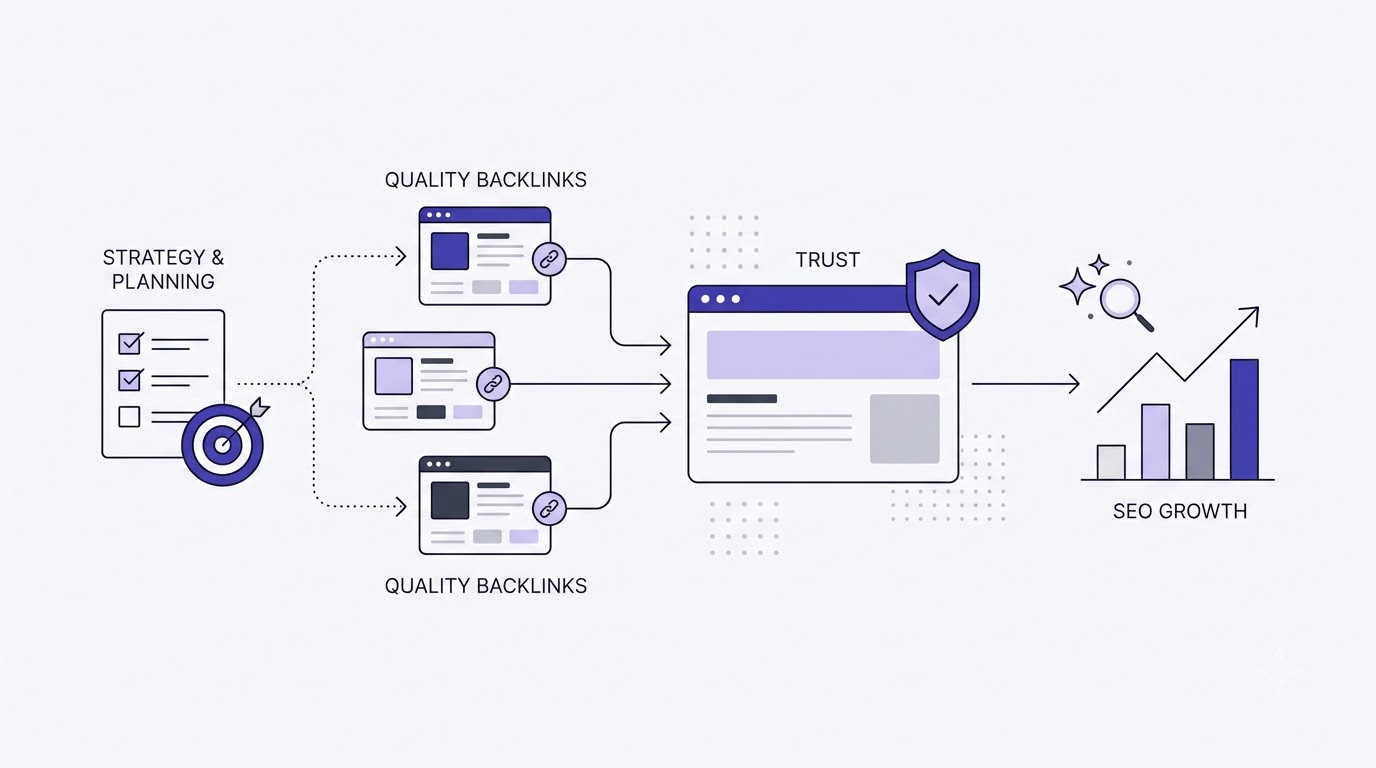
Start with the basic vocabulary, because nothing after this makes sense without it. A backlink is just a link from someone else’s website pointing to yours. That’s it. Google, and increasingly AI systems that answer questions directly, both treat these links as a signal of trust. If enough relevant, decent sites link to a page, that page is probably worth something. It’s the internet’s version of a recommendation. Nobody trusts a business that just says “we’re the best” about itself. People trust it more when someone else says it.
Now here’s the distinction that actually matters, the one most guides skip right past. Link building is an activity. A link building strategy is a system. Link building means going and doing something, guest posting, cold emailing, whatever. A link building strategy means first knowing where you stand, deciding what you actually need those links to do, building something worth linking to, then picking the specific tactics that fit that goal, running them consistently, and checking whether it’s working. One is an action. The other is a decision-making process that tells you which actions to take and in what order.
This is exactly why “just go do guest posting for a month” fails so often. There’s no baseline to measure against. Nobody knows if 10 new backlinks is good or terrible without knowing where they started. There’s no clear target, so there’s no way to know when to stop or change course. And the tactic itself might not even fit the business. Guest posting is great for building topical authority in a niche. It’s a waste of time if the actual goal is getting a local service business found in local search results. Random tactics fail because nobody asked what the tactic was supposed to accomplish before starting it.
One more thing worth clearing up early, because it comes up constantly now: is link building even still relevant with AI search taking over? Yes, and here’s why. Search engines still use backlinks as one of their core ranking signals, that hasn’t changed. What’s actually shifted is that AI answer engines are now doing something similar, pulling in and citing sources they consider credible, and credibility signals like backlinks and mentions feed into that too. A real link building strategy in 2026 has to think about both, not just classic blue-link rankings.
Worth remembering: A backlink is another site vouching for yours in public. A link building strategy is what decides which votes you actually go after, and in what order, instead of chasing every possible link the same way.
The Building Blocks: Types of Backlinks You Need to Understand First
Before any of the strategic decisions later in this guide make sense, the basic vocabulary of backlink types needs to be locked in. Skip this and half of what comes later will feel confusing.
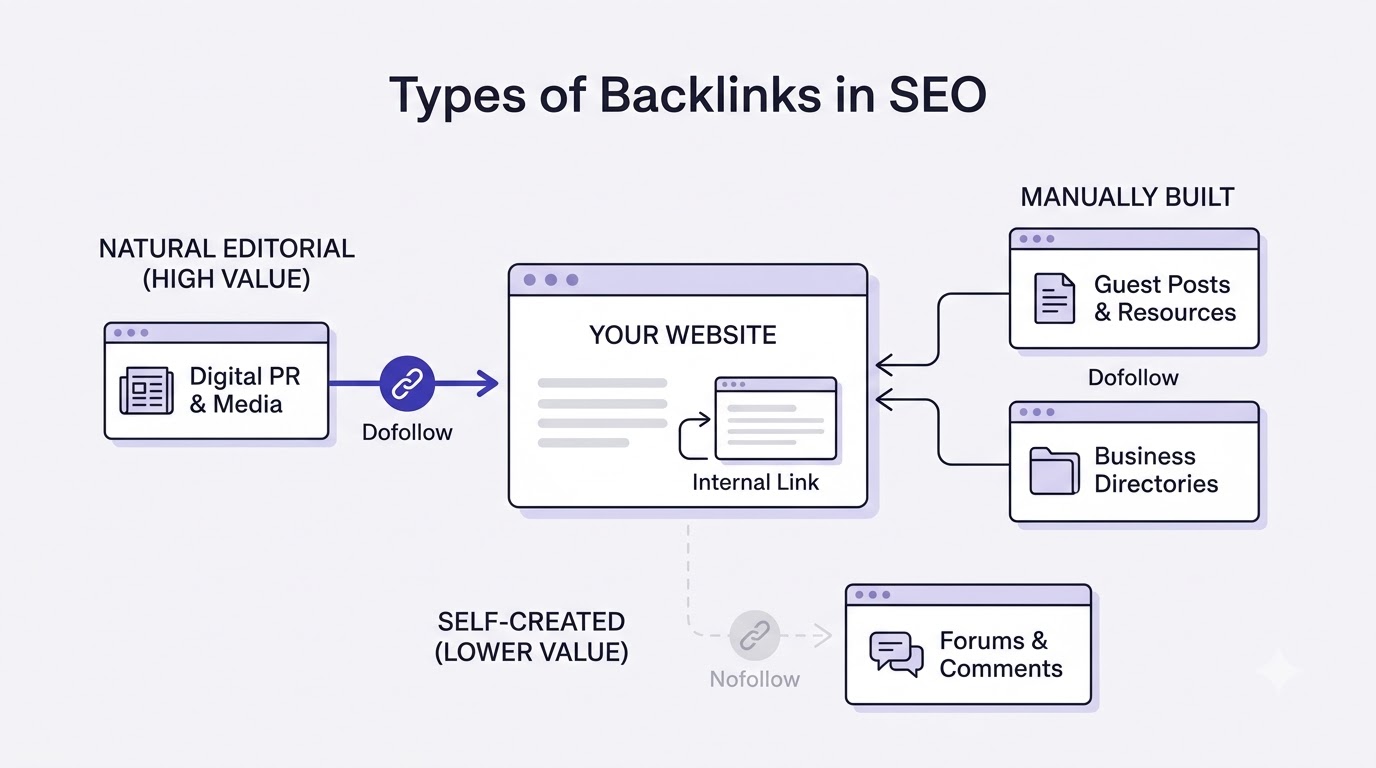
Dofollow versus nofollow is the first split. A dofollow link passes what’s often called “link equity,” basically a chunk of trust and ranking value from the linking site to yours. A nofollow link has an attribute added that tells search engines not to pass that value. Google also introduced two more specific attributes a few years back: “sponsored” for paid placements and “UGC” for user-generated content like blog comments or forum posts. Google’s treated these more as hints than strict rules since then, but using them correctly still matters, especially for anything involving paid or sponsored content.
Then there’s the split between editorial, manually built, and self-created links. Editorial links happen naturally, someone reads your content and links to it without you asking. Manually built links are the ones actually earned through outreach, guest posts, resource page pitches, that kind of thing. Self-created links are the ones added by the site owner themselves, blog comments, forum signatures, business directory listings. These get progressively lower in value in that order, and self-created links done at scale is exactly the kind of thing that gets flagged as spam.
Internal versus external links trips up beginners constantly, so it’s worth a clear line. Internal links point from one page on a website to another page on the same website. External, or inbound, links point from a different website entirely into yours. Both matter, and internal linking specifically gets covered properly later in this guide, because it’s one part of a strategy that’s entirely within anyone’s control.
Finally, the actual types of link sources worth knowing by name: guest post links, earned by contributing content to another relevant site. Resource page links, where a page gets added to someone’s curated list of helpful links on a topic. Directory links, simple business or niche listings. PR and media links, earned when a journalist or publication cites something. Forum and comment links, generally the lowest value of the group, and worth understanding why: they’re easy to spam at scale, so search engines discount them heavily, and most carry the nofollow attribute anyway.
Backlink Types at a Glance
| Type | How It’s Earned | Typical Value |
|---|---|---|
| Editorial (natural) | Someone links to your content unprompted | Highest |
| Guest post link | You contribute content to another site | High, if site is relevant |
| Resource page link | Your page gets added to a curated list | Medium-High |
| Digital PR/media link | Journalist cites your data/story | High |
| Directory link | Listing in a business/niche directory | Low-Medium |
| Forum/comment link | Posting a link in a comment/thread | Low |
What Makes a Backlink Actually Good
Not every backlink is worth the same. Some are worth chasing hard. Some are barely worth the time it takes to send the outreach email. Knowing the difference is what turns a pile of tactics into an actual filter for deciding what’s worth pursuing.
Relevance matters more than almost anything else on this list, and it’s the thing beginners underrate the most. A link from a site that’s topically connected to the business, even a smaller one, does more for rankings and for actual referral traffic than a link from some massive, unrelated site that just happens to have a high authority score. Google’s gotten genuinely good at understanding context. A backlink from a random general-interest blog to a plumbing business’s website looks odd. A backlink from a home renovation site to that same plumbing business makes complete sense.
Authority metrics come up constantly in this world, mainly Domain Rating from Ahrefs and Domain Authority from Moz. Both are useful as a rough gauge of a site’s overall strength. Neither is something Google actually uses internally, they’re third-party estimates built by those companies, not an official Google metric. Treat them as a helpful filter, not gospel. A site with a lower DR that’s genuinely relevant can still be worth more than a high DR site with no real connection to the topic.
Placement matters too, and it’s easy to overlook. A link sitting inside the actual body content of a page, surrounded by relevant text, passes more value and gets more visibility than one buried in a site’s footer or sidebar next to fifty other outbound links. If a guest post pitch results in a link stuck in an author bio at the bottom of the page instead of woven into the actual article, that’s a noticeably weaker placement.
On the dofollow versus nofollow question specifically, nofollow links still carry real value even without passing direct ranking equity. They bring referral traffic. They build brand visibility in front of a relevant audience. And a backlink profile made up entirely of dofollow links actually looks unnatural to search engines, since real, organic link profiles always include a healthy mix of both.
Then there’s anchor text, the actual clickable words in the link. This one deserves real attention because getting it wrong is one of the fastest ways to look manipulative. If dozens of sites all link back using the exact same keyword-stuffed phrase, like every single link reading “best digital marketing course India,” that pattern looks engineered, because it is. Natural link profiles have messy, varied anchor text: brand names, generic phrases like “click here” or “this guide,” partial keyword matches, and full URLs, all mixed together.
All four of these factors, relevance, authority, placement, and anchor text, work together as the actual filter a real link building strategy uses to decide what’s worth chasing and what to skip entirely.
Worth remembering: One link from a site your actual customers read is worth more than ten links from random high-DR sites with no relevance to your business. Relevance beats raw authority almost every time.
Step 1: Audit Your Current Backlink Profile Before Building Anything New
Most guides jump straight into tactics. That’s backwards. Step one of any real link building strategy is figuring out exactly where things stand right now, and skipping this step is how people end up building a strategy blind.
Here’s why this actually matters, beyond just being thorough. Nobody can set a meaningful target without knowing the starting number. “Get more backlinks” means something completely different for a site sitting at 15 referring domains versus one already sitting at 200. And there’s a real possibility of already carrying toxic links, spammy directories, old paid link placements from years ago, link farm remnants, that are quietly holding a site back right now without anyone realizing it.
Running the actual audit doesn’t require anything fancy. What matters is checking a few specific things: the total number of referring domains, not total backlinks, since one spammy site linking 500 times counts as one referring domain, not 500 separate wins. Look at the overall quality of the sites linking in, are they real, relevant, active sites, or clearly low-quality spam. Check the anchor text distribution for anything that looks over-optimized or suspicious. And look at where the existing links point, is it all going to the homepage, or spread across genuinely relevant pages.
Benchmarking against two or three real competitors adds context that’s easy to miss otherwise. If a competitor sits at 300 referring domains and the current site sits at 20, that gap tells you something real about how much work is actually ahead, and it stops the whole thing from feeling like guessing.
Finally, this audit is what decides whether the immediate next move is disavowing bad links or just building more good ones. If the existing profile is mostly clean with just a handful of low-quality links, it’s usually not worth the effort of a disavow file. If there’s a heavy pattern of spammy, clearly manipulative links, especially from a previous agency or a past mistake, that’s a different conversation entirely, and ignoring it while trying to build new links on top is building on a shaky foundation.
Step 2: Set the Goals That Will Actually Shape Your Link Building Strategy
This is the part that’s missing from almost every piece of content on this topic, and it’s honestly the most important step in the entire framework. Everything after this point, which tactics get picked, how outreach gets structured, what success even looks like, all of it depends on getting this step right.
“Get more backlinks” is not a goal. It’s a wish. It doesn’t tell anyone what to actually do differently tomorrow morning. A real goal has a number attached, a reason behind that number, and a rough deadline, even an approximate one.
The number itself should come directly from the audit and competitor benchmark done in Step 1, not pulled out of thin air. If a competitor’s sitting at 300 referring domains and the site in question is at 20, a goal of “50 new referring domains in six months” is ambitious but grounded. A goal of “1,000 backlinks by next month” isn’t a strategy, it’s a fantasy, and chasing it is exactly how people end up buying spammy link packages.
Beyond the number, the goal needs to specify what the links are actually meant to support. That’s a decision most people never explicitly make, and it changes everything downstream. Is the priority getting one specific page to rank higher for a competitive keyword? Building overall domain authority across the whole site? Driving actual referral traffic from the links themselves, regardless of SEO impact? Or building brand visibility and credibility through media mentions? Each of those points toward different tactics. A single-page ranking goal points toward the skyscraper technique and competitor gap analysis. A brand visibility goal points harder toward digital PR and journalist outreach.
And the timeline has to be realistic from the start, because link building results show up slowly, and setting expectations up front avoids the trap of calling the whole strategy a failure after six weeks when it was never going to move that fast.
Worth remembering: “Get more backlinks” isn’t a goal, it’s a wish. A real link building strategy starts with a number, a reason, and a deadline, even a rough one.
Step 3: Build Linkable Assets Before You Ask Anyone for a Link
Here’s a truth beginners consistently skip past: no outreach tactic in the world works if there’s nothing on the site actually worth linking to. This step has to happen before outreach starts, not somewhere alongside it.
A linkable asset is content specifically strong enough that someone else would genuinely want to reference it. That’s a different bar than content built purely to rank in search. Original data or research, even something as simple as a small survey of 50 customers with real numbers attached, tends to earn links because journalists and bloggers love citing actual data instead of generic claims. Genuinely comprehensive guides that cover a topic more thoroughly than anything else available. Free tools or calculators that solve a specific, narrow problem well. Strong custom visuals, infographics or original diagrams, not stock images. And honestly, opinionated or contrarian takes on a topic tend to earn links too, because people love linking to something that disagrees with the conventional wisdom in a defensible way.
It’s worth being direct about something here: content that ranks well in search and content that earns backlinks are not automatically the same thing. A solid, well-optimized how-to article can rank just fine without ever earning a single external link, because it’s useful to read but gives nobody a reason to cite it. A piece built around original data or a genuinely new angle earns links specifically because it gives other content creators something worth referencing.
Before assuming everything needs to be built from scratch, it’s worth auditing existing content first. Sometimes a decent article already exists that just needs an upgrade, more original data added, a stronger visual, an update with more current numbers, to turn it into something genuinely link-worthy instead of starting the whole thing over.
Step 4: Choose the Right Tactics for the Job
This is the biggest section in this guide, and it needs to be treated differently than a typical “here are 8 link building tactics” list. Every tactic below only works when it’s matched to the actual goal set back in Step 2. Picking guest posting because it’s the most talked-about tactic, when the real goal was local visibility, wastes months.
Guest posting still works in 2026, but the version that works looks nothing like the spammy, mass-produced guest post networks that gave the tactic a bad name years ago. It means genuinely contributing something useful to a relevant site’s audience, not stuffing a keyword-optimized link into generic filler content. This fits best when the goal is building topical authority within a specific niche, since every guest post also puts the writer’s name and expertise in front of a new, relevant audience.
Digital PR and journalist outreach means providing expert quotes or original data to journalists working on a story, in exchange for being cited with a link. Worth being upfront here: HARO, the platform that used to dominate this space, shut down in late 2024 after Cision retired it. It’s since come back under new ownership as a simpler, free newsletter of journalist queries, and a handful of other platforms have filled the same space. The underlying tactic never actually died, since journalists still need expert sources on deadline. This fits best for brands that genuinely have data or a real story worth citing, and it tends to earn the highest-authority links of any tactic here, since national and industry publications carry serious weight.
Broken link building means finding dead, 404-ing links on relevant sites and reaching out to suggest the site owner replace it with a working link to comparable content. This works because it solves a real, small problem for the site owner instead of just asking for a favor. It fits best for sites that already have strong existing content ready to serve as the replacement, and it suits people with limited time for constant outreach, since the ask itself is genuinely useful to the recipient.
The skyscraper technique means finding a piece of content that’s already earned a meaningful number of backlinks, building something noticeably better, more current, more thorough, better designed, then reaching out to the same sites that linked to the original, asking if they’d consider the improved version instead. This is high effort, since it demands genuinely better content, not just a slightly longer version. It fits best for competitive, well-covered topics where a lot of existing content already has traction worth improving on.
Resource page link building means finding curated list pages, the “best tools for X” or “helpful resources on Y” pages that plenty of niche and informational sites maintain, and pitching inclusion. It’s relatively low effort and fits well for niche sites and situations with a limited outreach budget, since these pages are often maintained by smaller sites that are genuinely happy to add a useful resource.
Competitor backlink gap analysis means looking at where competitors are earning links that the site in question isn’t, then going after the realistic, relevant ones from that list. This is arguably the best starting tactic for anyone building a strategy completely from zero, since it removes the guesswork. If three competitors all have a link from the same industry directory or resource page, that’s a strong sign it’s worth pursuing too.
Unlinked brand mention reclamation means finding places online where the brand’s already been mentioned by name but without an actual link, and simply asking the site to add one. This is low effort and genuinely high conversion, since the mention already exists, the ask is small, and it fits best for more established brands that already have some media coverage or public mentions to work with.
Internal linking strategy gets left out of almost every “link building” article, and that’s a real gap. Internal links, links from one page on a site to another page on the same site, pass authority around internally and sit entirely within anyone’s own control, no outreach, no relying on someone else saying yes. Every link building strategy should include a deliberate internal linking pass regardless of what the primary goal is, because it’s the one lever that never depends on convincing anyone else.
Matching Tactics to Strategic Goals
| Tactic | Effort Level | Best Fit When the Goal Is |
|---|---|---|
| Guest posting | Medium-High | Building topical authority in a niche |
| Digital PR/journalist outreach | High | You have data or a story worth citing |
| Broken link building | Medium | Strong existing content, limited outreach time |
| Skyscraper technique | High | Ranking on a competitive, well-covered topic |
| Resource page outreach | Low-Medium | Low budget, niche informational sites |
| Competitor gap analysis | Medium | Starting from zero |
| Unlinked mention reclamation | Low | Established brand with existing coverage |
| Internal linking | Low | Every situation, regardless of the above |
Step 5: Build an Outreach System, Not a One-Off Email Blast
Picking the right tactics doesn’t matter much if the outreach behind them is weak or, worse, a one-time effort that fizzles out after the first attempt. This step is about building outreach as something repeatable, not a single sprint.
Finding the right prospects starts with the relevance filters covered earlier, not just “any site with a high DR.” A list of 200 random high-authority sites with zero topical connection to the business is a worse starting point than a list of 40 genuinely relevant sites, even at lower authority scores.
Finding the right contact matters more than people assume. Sending a pitch to a generic info@ inbox often means it never reaches an actual decision-maker. A few extra minutes tracking down the actual content editor, site owner, or the specific author of a relevant existing article usually pays off far more than the time it costs.
What actually gets an outreach email a reply comes down to a few consistent things: specificity, referencing something real and specific about the site or the exact page being pitched, not a generic template that could be sent to anyone. Brevity, since nobody wants to read six paragraphs before understanding what’s actually being asked. Skipping the fake flattery, “I love your website” convinces nobody and reads as exactly what it is. And a genuinely clear ask, stated plainly, instead of vague hinting around the point.
The follow-up sequence matters more than most people realize. Most outreach dies not because the first email was bad, but because there was never a second one. People are busy, emails get buried, and a polite, short follow-up a week later catches a real chunk of replies that the first email alone never would have.
All of this only works as a strategy if it’s treated as a system, not a one-time task. That means actual templates that get refined over time based on what gets replies, and a simple tracking sheet logging who’s been contacted, when, and what the outcome was. A strategy needs something sustainable enough to run for months, not a single burst of effort that stops the moment it feels tedious.
Worth remembering: Nobody owes you a link because you asked nicely. They link to things that make their own content or audience better. Lead with that, not with “I loved your article.”
Step 6: Tools That Support Execution at Each Stage
Naming exact tools always comes with an expiration date, since specific products shift and get replaced. What stays consistent is the category of tool needed at each stage, so here’s the breakdown by function.
Tools by Function
| Category | Beginner-Friendly | Advanced/Paid |
|---|---|---|
| Backlink analysis | Google Search Console, Ubersuggest | Ahrefs, SEMrush, Moz |
| Prospecting/outreach | Hunter.io free tier, manual research | Pitchbox, BuzzStream |
| Broken link finding | Check My Links (browser extension) | Ahrefs Broken Link Checker |
| Digital PR/journalist requests | Free journalist request platforms | Paid PR platforms |
| Disavow/toxic link check | Google Search Console | Ahrefs/SEMrush toxic score |
Google Search Console deserves a specific mention here because it’s free and genuinely underused. It shows real backlink data straight from Google itself, not a third-party crawler’s estimate, which makes it a solid starting point before ever paying for a more advanced tool.
What Undermines a Link Building Strategy: Tactics to Avoid
Every shortcut in this section promises faster results. None of them deliver anything worth having, and understanding exactly why matters more than just being told to avoid them.
Buying links directly violates Google’s guidelines, and the risk isn’t hypothetical. Manual action penalties are real, documented, and can tank a site’s rankings overnight, sometimes taking months to recover from even after the offending links are removed or disavowed.
Private Blog Networks, PBNs, are networks of sites built specifically to link back to a “money site,” dressed up to look like independent, legitimate websites. Google’s gotten increasingly good at detecting the footprints these networks leave behind, shared hosting patterns, similar site structures, unnatural linking patterns, and PBNs get deindexed regularly. Losing an entire network of sites built over months, sometimes years, for a short-term ranking boost is a genuinely bad trade.
Reciprocal link exchanges at scale are worth separating from natural, occasional link exchanges. Two genuinely relevant businesses linking to each other once in a while is normal and fine. A scheme built around dozens or hundreds of sites all agreeing to link to each other specifically to manipulate rankings is a different thing entirely, and it’s exactly the kind of pattern Google’s algorithms are built to detect.
Comment spam and mass forum link dropping rarely work anymore anyway, since most of these links carry the nofollow attribute and the platforms themselves have gotten aggressive about detecting and removing spam. Beyond not working, it actively damages a brand’s reputation in those communities.
Low-quality guest post networks and paid guest post farms deserve a specific warning, since they’re often marketed as legitimate guest posting, just faster. These are usually networks of low-quality sites built purely to sell placements, and Google’s manual review teams specifically target this pattern.
Understanding what an actual Google manual action penalty looks like makes all of this concrete instead of abstract. It shows up directly inside Google Search Console as a manual action notice, and it typically means a meaningful drop in rankings or, in serious cases, a site being removed from search results almost entirely. Recovering means identifying and removing or disavowing the offending links, submitting a reconsideration request, and waiting, sometimes weeks, for Google to review and lift the penalty. None of that is fast, and none of it is guaranteed to work the first time.
Worth remembering: Every black hat tactic promises a shortcut. What it actually sells is a countdown to a penalty. The sites still ranking five years from now are the ones that didn’t take the shortcut.
Step 7: Measure Whether Your Link Building Strategy Is Actually Working
Everything up to this point means nothing without an honest check on whether it actually moved the needle. This step ties directly back to the goal set in Step 2, since success only makes sense measured against that original target.
Referring domains growth matters far more than total backlink count, and this distinction trips people up constantly. One site linking 50 times counts as one referring domain, not 50 wins. Tracking new referring domains over time gives a far more honest picture of real progress than watching a raw backlink number climb.
Organic traffic and keyword ranking movement should get tracked specifically against whatever the Step 2 goal actually was. If the goal was ranking a specific page higher, that page’s position for its target keywords is the number that matters, not some vague overall traffic bump.
Domain Rating or Domain Authority trend over time is worth watching, with the same caveat mentioned earlier: these are third-party estimates, not an official Google metric, and they tend to lag behind real changes by weeks or longer. Useful as a general trend line, not something to obsess over week to week.
Referral traffic from the links themselves deserves its own look, separate from pure SEO value. A link that sends real, engaged visitors is valuable even before factoring in any ranking impact at all.
Reporting on all of this monthly, not weekly, matches how link building actually moves. Links take real time to get indexed, get factored into rankings, and show any measurable shift. Checking weekly mostly just generates anxiety over noise. And every reporting cycle is also the moment to revisit the original Step 2 goal and honestly ask whether the current approach is working or whether the strategy needs adjusting.
Step 8: Your Link Building Strategy Roadmap: A 6-Month Plan
Every step above comes together here, into an actual sequence instead of a pile of separate ideas. This is what turns the whole framework from something informative into something someone can genuinely follow week by week.
6-Month Link Building Strategy Roadmap
| Month | Focus | Output |
|---|---|---|
| 1 | Audit + goal setting (Steps 1-2) | Full audit report, target referring domain count |
| 2 | Build 1-2 linkable assets (Step 3) | Published cornerstone content/data piece |
| 3 | Tactic selection + prospect list (Step 4) | List of 50-100 realistic prospects |
| 4 | Outreach round 1 (Step 5) | First 10-15 outreach emails sent |
| 5 | Broken link building + unlinked mentions | Second outreach wave, follow-ups on round 1 |
| 6 | Measure + refine (Step 7) | First links live, measure early referring domain growth against the Step 2 goal |
By month six, the goal isn’t necessarily having hit the full target set back in Step 2. It’s having a working system in motion, real prospects contacted, real content published, and real data on what’s converting and what isn’t, so months seven onward become about scaling whatever’s actually working instead of guessing all over again.
Common Mistakes That Derail a Link Building Strategy
Some patterns show up so consistently across beginners that they’re worth naming directly.
Chasing DR or DA numbers instead of relevance is probably the single most common mistake, and it comes straight from misunderstanding what those metrics actually measure. A high number on a completely unrelated site does far less than a lower number on something genuinely connected to the business.
Sending the exact same generic outreach template to hundreds of sites without any personalization gets ignored almost universally, and it’s easy to spot from the recipient’s side within the first sentence.
Giving up after a single outreach attempt instead of following up throws away a meaningful chunk of potential replies, since most positive responses come from the second message, not the first.
Building links only to the homepage, instead of spreading them across genuinely relevant internal pages, wastes a huge amount of the value a link could otherwise pass to the specific pages that actually need it.
Over-optimizing anchor text with the exact same keyword phrase repeatedly is one of the fastest ways to trigger suspicion from search engines, since real, organic link profiles never look that uniform.
And finally, skipping Step 1 or Step 2 entirely and jumping straight into tactics is the exact trap this entire guide exists to prevent. It’s the difference between doing link building and actually running a link building strategy.
Conclusion
Strip away all the individual tactics and this whole thing comes down to eight steps that build on each other: audit what’s already there, set a real goal instead of a vague wish, build something actually worth linking to, choose tactics that match that specific goal, run outreach as a system instead of a single burst, avoid the shortcuts that end in a penalty, measure against the original goal, and follow a roadmap instead of guessing at what to do next. That’s the actual link building strategy, not any single tactic on its own.
Results here are slow, and that’s genuinely normal, not a sign something’s broken. Anyone promising fast link building results is usually selling something that ends up hurting the site down the line, whether that’s a paid link package or a shortcut network that gets deindexed eventually. If a structured, step-by-step way of learning this properly sounds more useful than piecing it together alone, ADM Education’s SEO coverage walks through exactly this kind of hands-on framework. Either way, the actual first move here is small. Run the Step 1 audit this week. Before a single outreach email goes out.
Frequently Asked Questions
Is link building still important for SEO in 2026?
Yes. Backlinks remain one of the core signals search engines use to judge a page’s trustworthiness and authority. AI answer engines are increasingly citing sources they consider credible too, which means the underlying signal link building relies on is becoming relevant in more places, not fewer.
What’s the first step in building a link building strategy?
Auditing the current backlink profile. That means checking total referring domains, spotting any toxic or spammy links already in place, and benchmarking against a few real competitors before setting any targets or picking a single tactic.
How many backlinks does a website need to rank?
There’s no fixed number, since it depends heavily on the competitiveness of the target keywords and what competitors already have. A realistic goal comes from comparing the current backlink profile against two or three genuine competitors, not from a generic target pulled out of nowhere.
Is buying backlinks ever safe?
No. It directly violates Google’s guidelines, and the risk is a manual action penalty that can tank rankings and take months to recover from, even after removing the offending links.
What’s the difference between link building and digital PR?
Link building is the broader activity of earning backlinks through any method. Digital PR specifically means earning media coverage and links through journalists and publications, usually by providing expert commentary or original data. Digital PR is one tactic that fits inside a broader link building strategy.
How long does it take for a link building strategy to show results?
Generally a few months at minimum before meaningful ranking movement shows up, since links need time to get discovered, indexed, and factored into rankings. Setting a realistic timeline during the goal-setting step avoids judging the strategy too early.
Do nofollow links have any SEO value?
They don’t pass direct ranking authority the way dofollow links do, but they still bring real referral traffic, build brand visibility, and contribute to a natural-looking link profile, which itself has value.
What’s a good response rate for link building outreach?
Response rates vary a lot depending on how targeted and personalized the outreach is, but a small percentage of genuinely relevant, well-personalized pitches converting is normal and shouldn’t be read as failure. Volume and consistent follow-up matter more than any single email’s success.
Can a small business run a link building strategy without hiring an agency?
Yes, especially using lower-effort tactics like resource page outreach, unlinked mention reclamation, and internal linking, none of which require a large budget. It takes real time and consistency, but the framework doesn’t require an agency to execute.
How do I know if a backlink is hurting my site?
A backlink audit is the way to find out, checking for links from clearly spammy, irrelevant, or low-quality sites, along with any signs of manipulative patterns like heavily over-optimized anchor text pointing from many sites at once.
Is guest posting still effective for link building?
Yes, when it’s done properly, meaning genuinely useful content contributed to relevant sites, not mass-produced filler stuffed with keyword-optimized links. The spammy version of guest posting that gave the tactic a bad reputation doesn’t work anymore and risks penalties.
How often should a link building strategy be reviewed or adjusted?
Monthly is a realistic cadence, matching how slowly link building results actually show up. Each review is a chance to check progress against the original goal from Step 2 and decide whether the current tactics are working or need adjusting.