


Somebody on your team gets an email at 9 a.m. offering a guest post on a DR 70 site for $150. Another person in the same Slack channel swears guest blogging died in 2014 and that anyone still doing it is begging for a penalty. Both of them are partly right, and that’s exactly why Guest Blogging for SEO is one of the most confusing topics in marketing right now.
Here’s the history in one breath. For years, people wrote cheap articles, stuffed an exact-match link into the bio, and watched rankings climb. Then Google noticed. In January 2014, Matt Cutts, who ran Google’s webspam team back then, published a post saying guest blogging as a link-building shortcut had become spammy. Plenty of SEOs heard ‘never do it again’ and moved on. Plenty of others kept going and just got quieter about it. Twelve years later, both groups are still around, and the argument hasn’t ended.
The truth sits in the middle, and it’s more useful than either camp admits. Guest posting for links alone, at scale, with keyword-rich anchors, is the version that gets sites into trouble. Guest posting as a way to get your name, your ideas and your brand in front of a relevant audience, with a link that makes sense, still works. It also matters in a new way now, because AI search tools like Google’s AI Overviews and ChatGPT pull from pages that mention brands, not just pages that link to them.
This guide walks through what Google actually allows today, how guest posts move rankings (and how they don’t), how to find sites worth pitching, how to write the pitch and the post, which mistakes get people burned, and how to measure whether any of it paid off. Everything is written for beginners and small teams, so every term gets explained the first time it shows up.
What You Will Learn in This Guide
Before getting into the details, here’s a quick map of what’s coming. Each point below is a full section further down, so you can read straight through or jump to the part that matches the problem you’re stuck on right now. Nothing here assumes you’ve done outreach before.
- Whether Guest Blogging for SEO still works in 2026, and what changed since Google’s 2014 warning
- How Google’s current link spam rules treat guest posts, nofollow, sponsored and paid links
- Exactly how guest posts help rankings, referral traffic, brand mentions and AI search visibility
- How to find guest posting sites using search operators, competitor backlinks and Ahrefs or Semrush
- How to spot link farms and low-quality sites before you waste a week on a pitch
- A step-by-step process for pitching, writing, negotiating links and promoting your post
- The mistakes that cause penalties and wasted budgets, with real examples
- How to measure results in Google Search Console and Ahrefs, plus a realistic 90-day plan
- 12 frequently asked questions, answered in plain language
TL;DR
Short on time? This is the version you can screenshot and keep. Every line below is explained properly in the sections that follow, with examples and the mistakes to watch for at each step.
- Guest Blogging for SEO still works in 2026, but only when the goal is relevance and real readers, not link volume.
- Google treats large-scale guest posting campaigns with keyword-stuffed anchor text as link schemes, so paid and mass-produced posts carry real risk.
- A good guest post earns traffic, a brand mention and one natural link, and those mentions now feed AI search results too.
- Pick sites by their organic traffic and topic fit, not by Domain Rating or Domain Authority alone.
- Track referral visits, ranking changes and branded searches for at least 90 days before deciding a campaign worked or failed.
Does Guest Blogging for SEO Still Work in 2026? The Honest Answer

Yes, it still works, but the version that works looks nothing like the version people sold in 2012. The old playbook was volume: forty weak articles, forty exact-match links, done. The version that survives is slower, smaller and more editorial. This section breaks down what changed and why.
What Guest Blogging for SEO Actually Means
Guest blogging for SEO means writing an article for someone else’s website, usually in your own field, and getting credit in the form of an author bio, a brand mention and often a link back to your site. The SEO part comes from the link and the mention. The marketing part comes from the readers who see your name.
That’s the simple definition. The practical version is messier. Some sites call it a contributor post. Some call it a byline article or a thought leadership piece. The label doesn’t matter. What matters is whether an editor read your draft, decided it helped their readers, and published it because of that. If money changed hands for the link, it’s a different thing, and Google treats it differently.
The Short Answer for 2026
Guest posting still helps when three things line up: the host site has real readers, your topic fits that audience, and the link appears naturally inside useful content. Remove any one of those and the benefit mostly disappears. Remove all three, and you’ve got a link scheme.
Honestly, the shift is about intent. In 2012 the point was to manufacture a link. Now the point is to earn a place in a conversation where your future customers already are. The links come as a side effect. Marketers who flip that order, who chase links first and readers second, are the ones getting burned. Marketers who treat it like PR with a byline usually do fine.
What Matt Cutts Actually Killed in 2014
In his January 2014 post, titled ‘The Decay and Fall of Guest Blogging for SEO,’ Matt Cutts said guest blogging had turned into something full of spam and low-quality offers. People remember the title and forget the nuance. He didn’t say all guest writing was banned. He said using it purely as a link-building tactic had decayed.
Look at what he was reacting to: emails from strangers offering ‘high-quality guest posts’ on sites nobody had heard of, with identical templates and zero editorial standards. That was the target. Real contributors writing for real publications weren’t. The confusion since then has mostly come from people reading the headline and never the post, then repeating ‘guest blogging is dead’ as if it were official policy.
What Google’s Link Spam Rules Say Today
Google’s spam policies list ‘link spam’ and give examples of link schemes. One of them is large-scale article campaigns or guest posting campaigns that use keyword-rich anchor text links. Another is buying or selling links that pass ranking credit. Both are still in the documentation, and both are enforced by SpamBrain, Google’s AI-based spam detection system.
Here’s the part people skip. Google also says links in sponsored or paid content should carry the rel=’sponsored’ attribute, and that user-generated links should use rel=’ugc’. A plain editorial guest post, where nobody paid for the link, is not on the banned list. The risk climbs with scale, repetition and money. One strong post a month on a relevant site isn’t the same thing as fifty posts a month on random ones.
How AI Search Changed What a Guest Post Is Worth
Tools like Google’s AI Overviews, ChatGPT and Perplexity don’t just count links. They read pages and pull out which brands and people get mentioned in connection with which topics. Ahrefs published research on this and found that brand mentions across the web tracked AI Overview visibility more closely than backlinks did.
That changes the value of a guest post. A mention on a respected industry site, even without a link, can help a model associate your name with your topic. So the goal isn’t just ‘get a followed link’ anymore. It’s ‘appear, repeatedly, in places that other people and machines already trust.’ That’s a quieter, longer game, and it rewards people who show up consistently.
How Guest Blogging for SEO Actually Moves Rankings
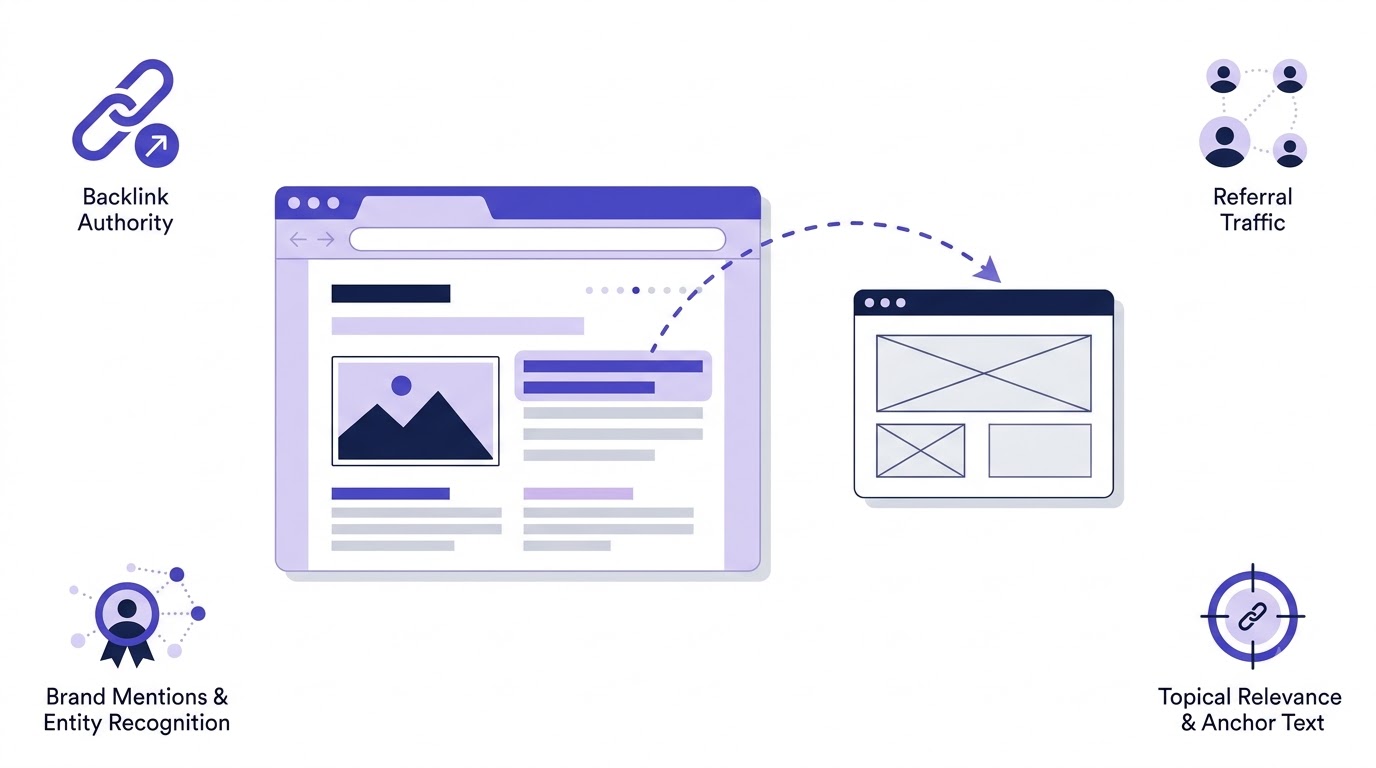
Guest posts help rankings through several separate channels, and most beginners only know about one of them. Understanding each channel tells you which sites to pursue and which to skip. Here’s how a single published post can pay you back in more than one way.
Backlinks and Authority Flow
A backlink is a link from another website to yours, and Google has used these as a trust signal since PageRank in the late 1990s. When a respected site links to a page, some of that site’s standing flows to the page. That’s the simplest reason guest posts ever worked.
But not every link carries the same weight. A link from a niche site with real traffic helps more than a link from a general-purpose blog with 12 monthly visitors. A link placed in the middle of a useful paragraph helps more than one buried in a footer. And one link from a site that already links to many competitors of yours can matter less than you’d think. That’s why quantity became a trap: ten weak links don’t equal one good one.
Referral Traffic and Real Readers
The link also sends people. A well-placed guest post on a site your customers read can bring 50 to 500 visits over its first few months, depending on the site’s audience and where your link sits. Those visitors behave differently from search traffic. They arrive already warmed up by the article they just read.
That matters for SEO in a roundabout way. Visitors who sign up for your newsletter, bookmark your tool or search your brand name later are generating behavior Google can see in branded search volume. Check your Google Analytics 4 referral report after a post goes live. If a guest post sent real readers who stayed for more than one page, you picked the right site, even if the link value was modest.
Brand Mentions and Entity Recognition
An entity, in search terms, is a person, brand or thing that Google can identify and connect to topics. When your name shows up repeatedly beside a subject on trusted sites, search engines and AI models start linking the two. Think of it as reputation that machines can read.
Guest posting is one of the few channels where you control the wording of that association. Your author bio says who you are. Your article proves what you know. Repeat that across ten relevant sites over a year and your name starts showing up when someone asks an AI tool who’s worth listening to on that subject. Unlinked mentions count here too, which is a big reason not to walk away from a site that only offers nofollow links.
Topical Relevance Beats Domain Rating
Domain Rating, or DR, is Ahrefs’ score for how strong a site’s backlink profile is. Domain Authority, or DA, is Moz’s version. Both are third-party estimates, not Google metrics. Google doesn’t use them, and they can be inflated with junk links.
So what should you check instead? Relevance. A DR 35 site that publishes only about email marketing is a better home for your email deliverability post than a DR 75 general news site. The first one’s readers care. The second one’s readers scroll past. When a niche site links to you, Google also gets a clean signal about what your page covers. Relevance and real traffic beat a pretty number every time.
Anchor Text, Nofollow and Sponsored Links
Anchor text is the clickable words in a link. Years ago people packed it with exact keywords like ‘best CRM software,’ and Google caught on. Today the safest anchors are natural ones: your brand name, your name, or a short description of the page. Branded and partial matches look like a human wrote them.
Then there are link attributes. A standard link is ‘dofollow’ and passes credit. Rel=’nofollow’ tells Google not to count it, rel=’sponsored’ marks paid placements, and rel=’ugc’ marks user content. Since 2019, Google treats these as hints, not strict rules. A nofollow guest post still brings traffic and mentions. Take the win and don’t beg editors to change attributes.
How to Find Guest Blogging for SEO Opportunities Worth Your Time

Finding sites is where most campaigns quietly fail. People grab the first list of ‘sites that accept guest posts’ from a Google search, and those are the same sites everyone else is spamming. Good prospecting takes an hour of research per ten sites, and it saves weeks of wasted writing.
Build a Target List With Search Operators
Search operators are special commands you type into Google to narrow results. Start with your topic plus phrases like ‘write for us,’ ‘guest post by,’ ‘contributor guidelines’ or ‘become a contributor.’ So you’d type something like: email marketing ‘write for us’. Then try intitle:’write for us’ email marketing to find pages with that phrase in the title.
The better trick is searching for names instead of invitations. Search for the byline of someone in your field, such as ‘by Neil Patel’ with a topic word, and you’ll find sites that already host outside authors. Put every result into a Google Sheet with columns for site, topic fit, estimated traffic, editor name and contact. A list of 40 sites you’ve actually checked beats a scraped list of 400 you haven’t.
Check a Site’s Traffic Before You Pitch
Before you write a word, paste the site into Ahrefs Site Explorer or Semrush’s Domain Overview and look at the organic traffic graph. You’re looking for a line that’s steady or climbing. A site that had 40,000 monthly visitors two years ago and has 800 now probably got hit by an update or got caught selling links.
Also check where the traffic comes from. If a site ranks for random terms like casino or loans while claiming to be a marketing blog, walk away. Open five recent articles and read them. Do they have real authors with real profiles? Are the comments or social shares alive? Five minutes of this saves you from publishing on a site that Google has quietly stopped trusting.
Spot Link Farms in Two Minutes
A link farm is a network of sites that exist mainly to sell links. They look the same: dozens of unrelated categories, every post ending with a ‘sponsored by’ link, a Contact page offering ‘guest post packages’ with a price table, and authors with stock photos. If you see those signs, close the tab.
Two more quick tests. First, scan the outbound links in recent posts. Real editorial sites link out to sources, studies and other publishers. Link farms link out to casino, CBD, loan and essay-writing pages. Second, check whether the site’s Ahrefs traffic is mostly from countries that don’t match its language. A site written in English with most of its traffic from random countries and no real brand searches is usually a link farm in disguise.
Mine Competitor Backlinks for Proven Sites
Your competitors have already done the research for you. Open Ahrefs Site Explorer, enter a competitor’s domain, open Backlinks and filter for ‘One link per domain.’ Then sort by DR or traffic and scan for guest posts. Look for the byline or author box in the linking page.
If three of your competitors all got guest posts on the same publication, that publication likes your topic and takes outside contributors. That’s a warm lead. Use Ahrefs’ Link Intersect tool (or Semrush’s Backlink Gap) to find domains that link to two or three competitors but not to you. Those are the cleanest targets you’ll find, because they’ve already shown they publish content like yours. Pitch them with a topic your competitors haven’t covered.
Look Beyond Blogs: Podcasts, Newsletters and Communities
A guest article isn’t the only way to earn a byline. Podcast interviews usually come with show notes pages that link to your site. Industry newsletters often accept contributed sections. Platforms like Substack, LinkedIn articles and Medium aren’t classic guest posts, but they build the same author profile.
One underrated option: expert quote requests. Platforms like Qwoted and Featured connect you to reporters and bloggers who need a quote on a topic. A two-sentence expert answer can land a link from a news site you’d never get through a traditional pitch. It’s not glamorous, and it takes maybe twenty minutes a week. But those links tend to be on strong, editorially clean pages.
Guest Blogging for SEO Step by Step: Pitch, Write, Publish
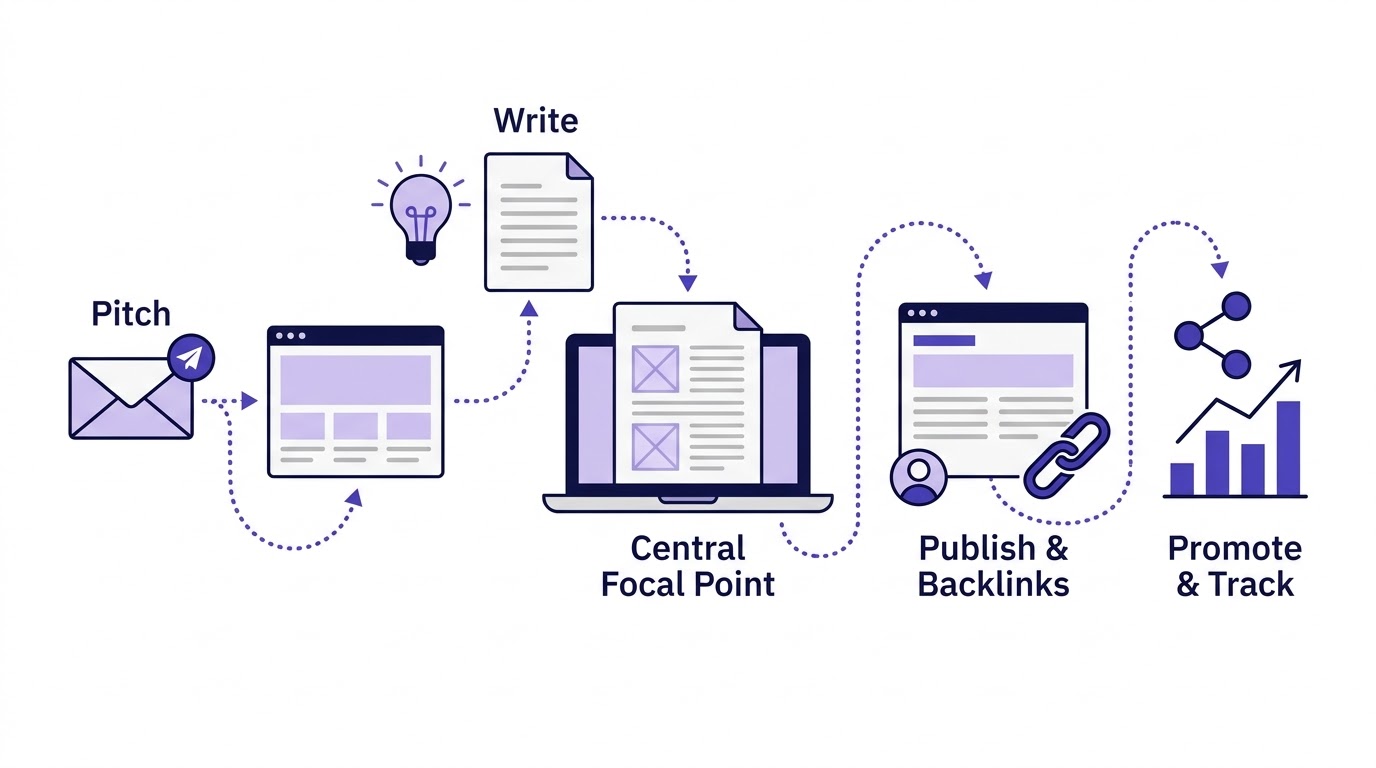
Once you have a list of real sites, the work becomes human. You’re asking a busy editor to read your email, trust you and give you space on their site. Everything in this section is about making that decision easy for them and good for you.
Write a Pitch Email That Gets Replies
Most pitches fail in the first line. Editors get dozens a week that start with ‘Hope you’re doing well’ and then ask for a link. Your pitch should open with something specific about their site, like an article you read recently and what you liked or what was missing from it. Then offer two or three headlines tailored to their readers.
Keep it short. Around 120 words is plenty. Say who you are in one sentence and link to two writing samples. Don’t mention SEO, backlinks or domain rating. Editors don’t care about your goals. They care whether the topic will get read. A decent response rate for cold outreach to sites you’ve researched is somewhere around 5 to 15 percent, so send a polite follow-up after five days. One follow-up. Not four.
Choose Topics the Host Site Cannot Easily Write
Search the host site for your topic first. If they’ve published six articles on ‘what is SEO,’ they don’t need a seventh. Find the gap: a case study, a data point from your own work, a process that’s rarely documented, or a contrarian opinion backed by evidence.
Here’s a useful test. Would a staff writer at that publication have the access or the experience to write this? If yes, the editor has no reason to say yes to you. If the answer is no, because the post uses your client data, your tool screenshots or your first-hand experience, you’ve just given them something they can’t get elsewhere. That’s your actual value. The link is the thank-you for it.
Write the Post Like It Is Your Best Work
A guest post is a permanent business card. Treat it like a flagship article. Follow the site’s formatting: heading style, paragraph length, image count. Check the editor’s last five posts for the average word count and match it. Most hosts want 1,200 to 2,000 words.
Back every claim with something real. Use tool names, specific numbers, screenshots and short examples. Add two or three links to other credible sources, not just to yourself. And never reuse the post on your own site, even partially. Duplicate content makes editors nervous and gives them a reason to unpublish. Write it once, write it for them, and let your own blog have its own separate ideas.
Negotiate Your Author Bio and Links
The author bio is usually the safest place for a link, and it’s where editors are most flexible. Ask for a 40 to 60 word bio with your name, role, one credential and a link to either your homepage or a relevant page. Branded anchors like your company name work best.
Inside the article, one contextual link to a useful page on your site is reasonable if it genuinely helps the reader. Two is a stretch. Three looks like a campaign. Don’t haggle over dofollow versus nofollow in the first email. Build the relationship first. Editors who like your first post usually offer better terms on the second, including a profile page, a headshot and sometimes a regular column.
Follow Up and Promote After Publishing
The work doesn’t end when the post goes live. Share it on LinkedIn and X, tag the publication, and send it to your email list. Traffic in the first week signals to the editor that you bring readers, which is the best way to get invited back.
Then watch the page. Reply to every comment. Update the post if a statistic changes. Add the published URL to a spreadsheet with the date, the link target, the anchor used and the DR of the host. Three months later, that sheet tells you which sites did something and which ones were a waste. Most people skip this step, and then they can’t tell whether their effort is working at all.
Guest Blogging for SEO Mistakes and Risks That Cost Rankings
Most penalties and wasted budgets come from a short list of repeat mistakes. None of them are complicated, and all of them are tempting when a deadline or a target is staring at you. Knowing them in advance makes the difference between a campaign that builds trust and one that needs cleaning up.
Paid Posts and Guest Post Marketplaces
Buying a guest post is the riskiest shortcut in the whole topic. Marketplaces list sites by DR and price, often from $50 to $500 a post, and they make it feel normal. It isn’t. Google’s spam policies treat links exchanged for money as link spam unless they carry the rel=’sponsored’ attribute, and a paid link that passes ranking credit is exactly what SpamBrain looks for.
The pattern is easy to spot from the outside. The same sites appear again and again, posts are 600 words with no author profile, and the topic has nothing to do with the host. Pay for a post and you’re also tying your brand to every other buyer on that site. If you do sponsor content, label it, use the sponsored attribute, and treat it as advertising, not SEO.
Exact-Match Anchor Text Overload
Picture a backlink profile where 60 percent of the anchors read ‘cheap running shoes online.’ Real websites never look like that. Real links come in a mix: brand names, URLs, page titles, plain phrases like ‘this guide’ and a few keywords. A profile heavy on one exact phrase is the fingerprint of a campaign.
Audit your anchors in Ahrefs’ Site Explorer under Anchors. If one commercial phrase sits above 10 or 15 percent, stop adding more of it. Switch to branded and generic anchors for the next dozen links. It’s boring advice, but it works. Google doesn’t need your anchor text to know what your page is about. It reads the whole article and the page around the link.
Publishing on Sites That Take Anyone
If a site accepts any article from any person on any topic, that’s not a publication. It’s an ad space with a blog theme. Google has gotten much better at ignoring these links, and in the worst cases it demotes the host site, which drags down whoever linked from it.
There’s a simple rule. If the editor’s reply asks nothing about your topic, your credentials or your outline, be suspicious. Real editors ask questions and sometimes say no. A reply that says ‘Sure, send the article, price is $120’ is a vending machine. Skip it, and use that time to pitch two real sites instead. The conversion rate on the real ones will surprise you.
Over-Optimizing Posts With Keywords and Links
A guest post isn’t a landing page. If the article mentions your target keyword every other paragraph and links to three different money pages, editors will cut the links or reject the draft. Readers will bounce, and Google’s systems will see a pattern.
Write to be useful first. Use the keyword where it fits and move on. If you want to learn how to place keywords without making a post sound robotic, the free on-page SEO lessons in the SEO hub are a good place to practice on your own content before you go and write for someone else’s site. Your goal is for a reader to finish the article and look up the author, not to feel they’ve been sold to.
Skipping Measurement and Tracking
A guest post that nobody tracks is an expense you can’t defend. Teams publish a dozen posts, feel busy, and then can’t say whether any of them moved a ranking or sent a customer. That’s how budgets get cut.
Set up tracking before you pitch. Create a UTM tagged link for each post (utm_source set to the site name, utm_medium set to guest-post), and log it in your sheet. Check Google Analytics 4 for sessions and conversions from those sources, and check Google Search Console for impressions on the page you linked to. Without this, you’re running on vibes, and vibes don’t survive a budget meeting.
Measuring Guest Blogging for SEO Results: A Realistic 90-Day Plan
Results from guest posting come slowly and in pieces. Rankings rarely jump after one post. What you want is a pattern across several posts and several metrics. This section shows what to track, which tools to use, and what a believable 90-day campaign looks like.
Metrics That Actually Matter
Five numbers tell you most of what you need. First, referring domains: the count of unique sites linking to you, found in Ahrefs or Google Search Console’s Links report. Second, referral sessions from each guest post in GA4. Third, impressions and clicks for the linked page in Search Console. Fourth, branded search volume for your name or company. Fifth, conversions from guest post traffic.
Ignore vanity numbers like total backlinks. One site can give you a hundred links from sidebar placements that mean nothing. Watch domains, not links. And compare each number to the same page’s performance before the guest post went live. Without a baseline, any improvement is just a story you tell yourself afterward.
Free and Paid Tools for Tracking Links
Start with free tools. Google Search Console’s Links report shows which sites link to you and which pages get the most links. Google Analytics 4 shows referral traffic under Acquisition. Ahrefs Webmaster Tools gives site owners a free backlink report on verified sites. Together those three cover most beginners.
Paid tools add speed and context. Ahrefs and Semrush both send alerts when a new link appears, and they show Domain Rating and traffic for every linking site. If you’re still deciding which platform fits your budget, the SEO and marketing tools collection has free utilities worth trying before any subscription. Pick one paid tool, learn it deeply, and stop collecting logins.
A Realistic 90-Day Campaign Example
Here’s a hypothetical, using round numbers, of how a small campaign tends to run. Picture a Shopify store selling organic skincare. The owner builds a list of 60 relevant sites: beauty blogs, wellness newsletters, dermatology-adjacent publications. After checking traffic and quality, 35 pass.
She sends 35 pitches in month one and gets around 8 replies, which is a typical rate. Four editors say yes. Two posts publish in month two and two in month three. Each brings 80 to 250 referral visits, one nofollow and three dofollow links, and a handful of newsletter signups. By day 90, branded search is up a little, and one linked product guide has moved from position 14 to position 9. Modest. Real. And repeatable. For more actual before-and-after numbers from real work, browse the case studies on Academy Of Digital Marketing.
When to Keep Going and When to Stop
Give a campaign at least three months before judging it. If you’ve published four or more posts on relevant sites and see zero referral traffic, zero branded search lift and no movement on linked pages, something’s off. Check the sites you picked, the topics you pitched and the placement of your links.
If the numbers look good, double down on the sites that sent traffic, not just the ones with the highest DR. Pitch those editors again with a follow-up topic and ask about a regular column. If numbers look bad on every site, the problem is usually the pitch or the topic, not the strategy. Fix one thing at a time. Change the pitch angle before you change the whole plan.
How Much to Budget for Guest Posting
Ethical guest posting costs time, not money. A single good post takes five to eight hours between research, pitching, writing and promotion. A small team doing two posts a month spends around 15 hours monthly. If you hire a freelancer to write drafts, expect $100 to $300 per article depending on depth.
What you shouldn’t budget for is the link itself. Once a payment shows up in the process, you’ve changed the rules. Better places to spend extra money: a good designer to make original graphics for your posts, a tool subscription like Ahrefs for prospecting, or a freelance editor who can polish drafts. Quality is what editors say yes to, and quality is what moves rankings.
Conclusion
Guest Blogging for SEO still works, but it rewards patience and punishes shortcuts. The people getting results aren’t sending 500 emails a week or buying packages from marketplaces. They pick a handful of relevant sites, pitch topics those sites can’t easily write themselves, and treat every post as a long-term business card with a link attached.
If you’re starting from zero, pick one topic you know better than most people and build a list of 20 relevant sites this week. Pitch five of them. If a structured path suits you better than piecing things together, the Alpha Marketer Foundation Program walks through SEO, content and outreach in one place. Then track the results for 90 days and let the numbers decide what to do next.
Want more practical guides like this one? Browse the free Learn hub for step-by-step articles on SEO, content and growth.
Frequently Asked Questions
These are the questions people ask most often about guest posting, taken from what shows up in Google’s People Also Ask boxes, Reddit threads and beginner forums. Each answer stands on its own, so you can jump straight to the one you need.
Is guest blogging still worth it for SEO in 2026?
Yes, when it’s done selectively. Guest posts on relevant, editorially strong sites can bring backlinks, referral traffic and brand mentions that help both traditional rankings and AI search visibility. Mass-produced posts with keyword-rich anchors and paid placements carry real risk, because Google’s spam policies treat them as link schemes.
Does Google penalize guest blogging?
Google doesn’t penalize guest blogging as a practice. It penalizes link spam, which includes large-scale guest posting campaigns with keyword-rich anchor text and paid links that don’t use the sponsored attribute. A few well-placed editorial guest posts on relevant sites are unlikely to cause problems.
How many guest posts should I publish per month?
For most small sites, one to four quality posts per month is a sensible range. Quality and relevance matter more than count. If a single post takes you eight hours to research and write properly, you can’t realistically do twenty a month without cutting corners that editors and Google will notice.
Are guest post links dofollow or nofollow?
It depends on the site. Many publishers use nofollow or sponsored attributes on guest post links, while others allow dofollow links in the author bio or body. Since 2019 Google treats these attributes as hints, so even a nofollow link can bring traffic, mentions and some indirect SEO benefit.
How much does a guest post cost?
Ethical guest posting is free to publish on the host site. The cost is your time, or a freelancer’s fee of roughly $100 to $300 per article. Sites that charge $50 to $500 for a placement are selling links, which breaks Google’s link spam policies unless the link is marked as sponsored.
What is a good Domain Rating for a guest post site?
There’s no magic number. A DR between 30 and 60 on a site with steady organic traffic and a relevant audience is often better than a DR 80 site that’s off-topic. Check traffic trends and topical fit in Ahrefs or Semrush before looking at the score.
How do I find guest blogging opportunities?
Combine three methods. Use Google search operators like ‘write for us’ plus your topic, study the backlink profiles of your competitors in Ahrefs, and look at where your industry’s authors already publish. Put every site into a spreadsheet with traffic, topic fit and editor contact before you send a single pitch.
What should I include in a guest post pitch email?
Keep it around 120 words. Include a specific compliment or observation about the site, two or three tailored topic ideas, one sentence about your background and links to two writing samples. Leave out talk of backlinks and SEO. Editors respond to topics that will help their readers.
Can I reuse a guest post on my own blog?
No, not as a copy. Most editors require original content, and duplicate versions can cause indexing confusion. If you want to expand on the idea on your own site, write a fresh article with a different angle and link to the guest post as a source.
Does guest blogging help with AI search and AI Overviews?
It can. AI search tools draw from pages that mention brands and authors in connection with specific topics. Ahrefs research found brand mentions tracked AI Overview visibility more closely than backlinks. Consistent bylines on trusted, relevant sites help build that association over time.
How long does it take to see results from guest blogging?
Expect a minimum of 60 to 90 days. Referral traffic can show up within days of publishing, but ranking changes and branded search growth usually take a couple of months and several published posts. A single guest post rarely moves a competitive keyword on its own.
Is guest blogging better than other link building methods?
Neither is universally better. Guest blogging gives you control over the message and builds author reputation, but it’s slow. Digital PR, original research and broken link building can earn links with less writing. Most healthy backlink profiles use a mix, with guest posts as one part of it.
What are the safest ways to do guest blogging for SEO?
Pick relevant sites with real traffic, pitch original ideas, use branded or natural anchors, limit yourself to one or two links, never pay for the link, and label any paid content as sponsored. Track every post in a spreadsheet so you can spot problems early.