

You open a blank document to write a product page. The cursor blinks at you. Forty minutes later the only thing on the screen is “Welcome to our company, we are a leading provider of quality solutions.” You delete it. Type it again. Delete it again. Honestly, almost everyone who has ever tried to write marketing copy has been stuck in that exact spot, and it has nothing to do with talent. Nobody told you where a sales message starts, where it goes next, and where it ends. Copywriting formulas fix that problem.
A formula is just a proven order for your thoughts. Somebody noticed that ads, sales letters and emails that worked kept following the same sequence: grab attention, make the person care, show a way out, ask for action. They gave the sequence a name, usually a catchy acronym, and now a beginner gets to borrow a path that has been tested for well over a hundred years. AIDA, the oldest one still in use, goes back to around 1898. Nobody has managed to kill it yet, and that tells you something.
This guide walks through the formulas that actually get used by working writers: AIDA, PAS, BAB, the 4Ps, FAB, QUEST, the 4 U’s for headlines, and a handful of others. Each one comes with a plain explanation, a before and after example, and the mistake that ruins it for most beginners. There is also a section on picking the right formula for the job in front of you, because knowing ten formulas and using the wrong one is worse than knowing two and using them well.
You don’t need a marketing degree for any of this. A laptop, a real product to write about (an imaginary one works fine for practice) and about an hour per formula is enough. By the end, a blank page stops looking scary. It starts looking like a form with the boxes waiting to be filled.
What You Will Learn in This Guide
- What copywriting formulas are, where they came from, and why they work on real readers
- How to write with AIDA, step by step, using a before and after example
- How PAS, BAB and the 4Ps handle problem-focused selling
- Which headline formulas get clicks, including the 4 U’s and number-based hooks
- How to adapt copywriting formulas for emails, social posts and landing pages
- How FAB, QUEST and Star-Story-Solution work on product and sales pages
- A simple way to choose the right formula based on your reader’s awareness level
- The mistakes that make formula-based copy sound robotic, and how to practice until it sounds like you
What Are Copywriting Formulas and Why Beginners Need Them
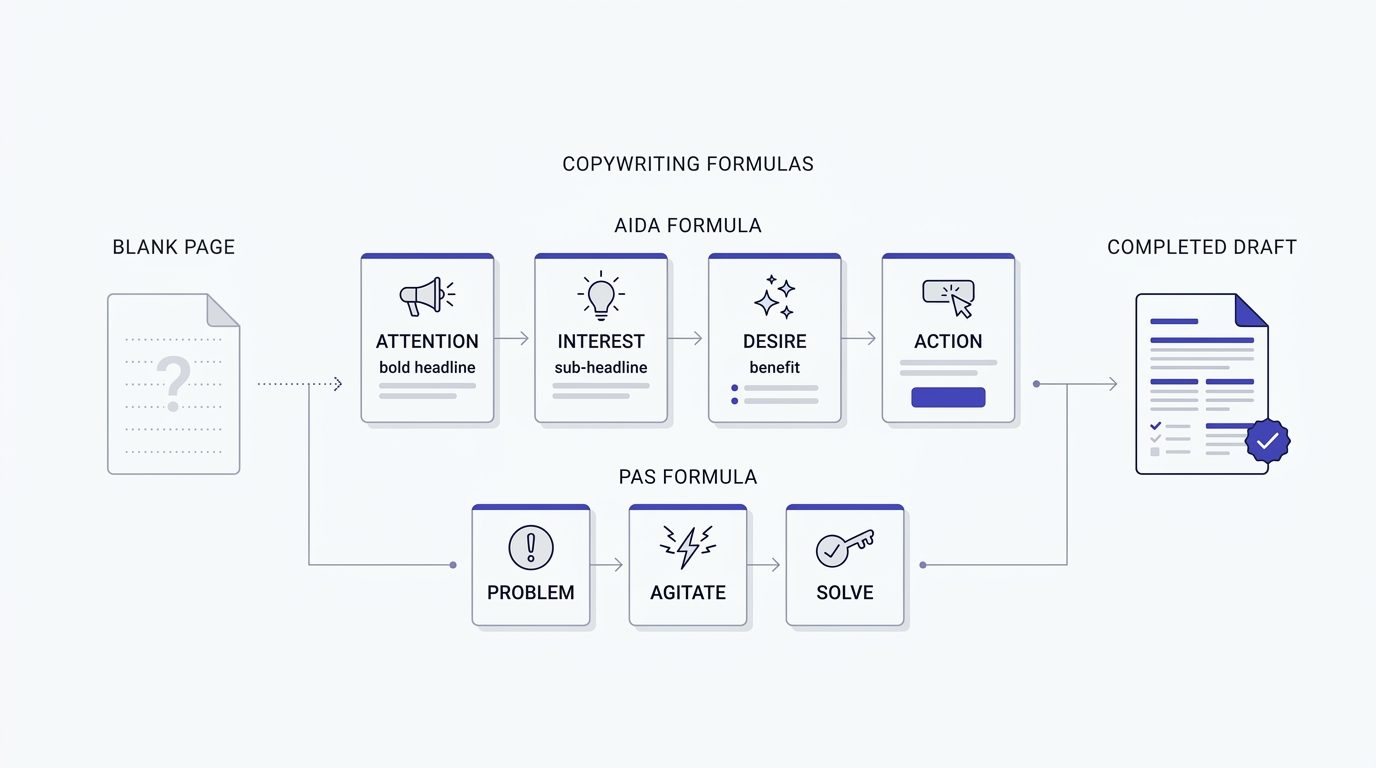
Copywriting formulas are repeatable structures that tell you what to say first, what to say next, and how to finish a piece of persuasive writing. Think of them as the skeleton under the words. The sentences are yours. The order comes from a pattern that has already worked on millions of readers, which saves you from inventing structure from scratch every single time.
What a Copywriting Formula Actually Is
A copywriting formula is a short sequence, usually named with an acronym, that maps the mental steps a reader goes through before they buy, click or reply. AIDA has four steps. PAS has three. The 4Ps has four. Each letter is a job the copy has to do before the reader is allowed to move on to the next one.
Here is the part that surprises beginners. A formula doesn’t tell you what words to use. It tells you what each paragraph is for. When you know a paragraph’s job (say, “make the problem feel real”), picking the words gets much easier, because you can judge every sentence against that job. Does this line make the problem feel real, or is it just filler?
That’s also why two writers can use the same formula and produce completely different pieces. The structure is shared. The voice, the details and the examples belong to whoever is typing.
Why the Blank Page Wrecks Beginners
Most beginners freeze because they try to do three things at once: decide what to say, decide the order, and make it sound good. That’s too much for one brain on one Tuesday afternoon. A formula takes the second job off the table. Order is decided. You only have to answer small questions like “what is the reader’s biggest annoyance here?” or “what happens if they ignore it?”
Small questions get answered. Big blank pages don’t. A student who has to write an email for a Pune coaching class can answer “what is a parent worried about on Sunday night before the exam?” in about thirty seconds. Asking the same student to “write a great email” can take an entire evening and still end with nothing.
Speed matters too, and not only for deadlines. The faster you get a rough draft out, the more time there is left to edit, and editing is where copy actually becomes good. Formulas buy you that time.
Formulas Are Scaffolding, Not Handcuffs
Some writers sneer at formulas. Their argument goes: real writers don’t follow templates, they feel their way through. Look at what experienced copywriters actually do, though. They follow formulas all the time, they’ve just done it for so long that the steps happen automatically. A veteran writing a sales email is running PAS or AIDA in the background without naming it.
The scaffolding comparison is useful. A builder doesn’t see scaffolding as a limit on the building. It holds things up until the walls can stand alone. Beginners lean on formulas heavily. After a few months, you’ll start bending them, merging two of them, skipping a step because the reader already knows it. That’s growth, not cheating.
The handcuff problem only shows up when someone treats the formula as the finished product. Pasting “Attention: … Interest: … Desire: … Action: …” as literal labels in front of customers would be silly. The labels are for you. The reader should never see them.
A Quick Look at Where These Formulas Came From
The history is short but worth knowing. E. St. Elmo Lewis, an American advertising pioneer, is credited with the idea behind AIDA around 1898, describing the steps a salesperson should guide a customer through. Claude Hopkins, John Caples and later David Ogilvy built the craft on testing: run two versions, count the responses, keep the winner.
Later writers boiled the lessons into smaller recipes. Dan Kennedy popularized Problem-Agitate-Solve in direct response marketing. Eugene Schwartz, in his 1966 book Breakthrough Advertising, described how the right message depends on how aware the customer already is of the problem and the product. Michael Masterson’s 4 U’s turned headline writing into a checklist.
What this tells a beginner is simple. These aren’t internet tricks invented last year for Instagram. They come out of decades of people measuring results with real money on the line, and that’s the reason they hold up. If you’re building a wider marketing skill set around them, the digital marketing guides on Academy of Digital Marketing show where copywriting fits next to SEO, ads and email.
AIDA: The Oldest of the Copywriting Formulas Still in Use
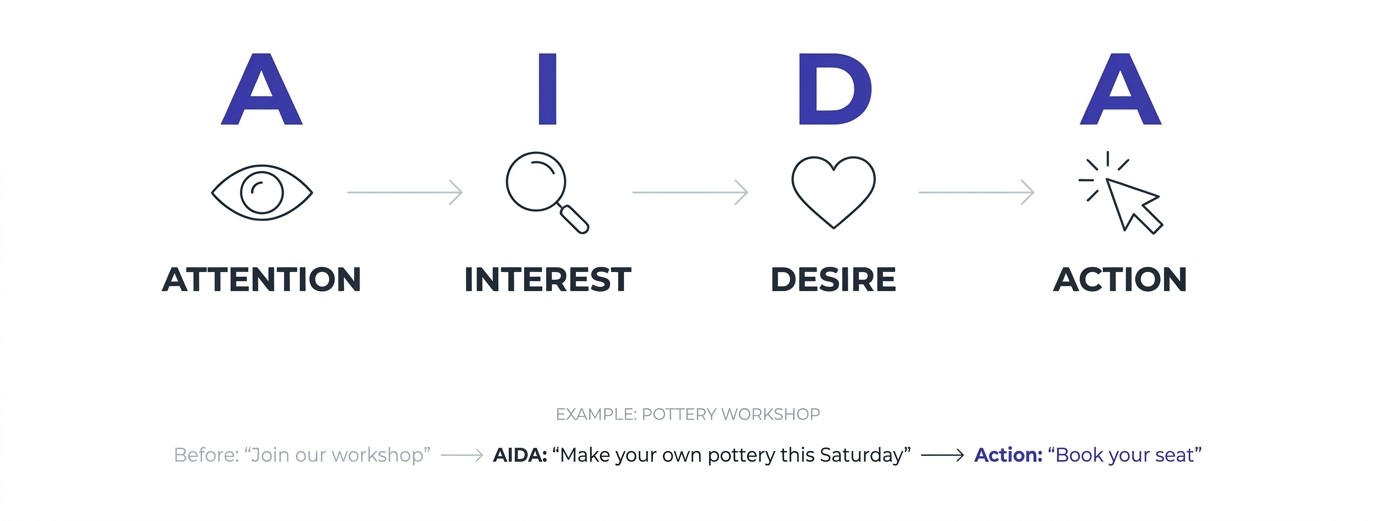
AIDA stands for Attention, Interest, Desire, Action. It’s the most widely taught of all copywriting formulas because it follows the way a person moves from noticing something to doing something about it. If you only learn one formula this month, make it this one, since almost everything else is a variation on the same idea.
Breaking Down the Four Letters of AIDA
Attention is the first line, the headline or the opening of a post. Its only job is to stop the scroll. Nobody is reading your ad on purpose. They’re half-distracted on a phone in a lift, so the opening has to interrupt the autopilot with something surprising, specific or personal.
Interest keeps them there. Once you’ve got a second of attention, you earn the next ten seconds by showing you understand their situation. Facts and details work better here than adjectives. “Saturday, three hours, eight people, wheel and clay included” is interesting. “A wonderful creative experience” isn’t.
Desire is where the reader starts picturing themselves with the result. Interest says “this exists.” Desire says “I want this.” You get there with outcomes, small scenes and proof, not with pushing harder. Action is the plain, specific next step: book, reply, tap, call. One action, stated clearly, with a reason to do it now.
A Full AIDA Example, Before and After
Say a small pottery studio is promoting a Saturday workshop. The first draft most beginners write looks like this: “Join our pottery workshop. We have experienced instructors and good facilities. Limited seats available.” It’s not wrong, it’s just forgettable, because every studio says the same three sentences.
Now run it through AIDA. Attention: “Your phone had you for nine hours today. Give your hands a turn.” Interest: “Saturday pottery, three hours, eight people maximum, wheel and clay included.” Desire: “By 5 pm you’ll carry home a bowl you made yourself, wobble and all, and you’ll defend that wobble for years.” Action: “Three seats left this Saturday. Message us on WhatsApp before Thursday to hold one.”
Same studio, same workshop, same price. The second version just knows what each line is for. And notice it has real numbers (nine hours, eight people, three seats, Thursday), which is what keeps a formula from sounding like a formula.
Where AIDA Goes Wrong
The most common AIDA mistake is spending the entire piece on Attention. Beginners write a clever, funny, slightly weird opening line and then crash straight into the offer. The reader got a laugh but no reason to care. Attention is the cheapest part of the sequence. Desire is the expensive one, and it needs the most words.
The second mistake is a vague Action. “Contact us for more information” gives the reader no reason to move today. Compare it with “Reply with your pincode and the Saturday batch time works for you.” Smaller, clearer actions get more responses. Always.
The third problem is using AIDA for everything. It works well for ads, short landing pages and announcement emails. For someone who doesn’t know they have a problem yet, or for a long sales page that needs to handle objections, other copywriting formulas do the job better, and the next section covers them.
Problem-Focused Copywriting Formulas: PAS, BAB and the 4Ps
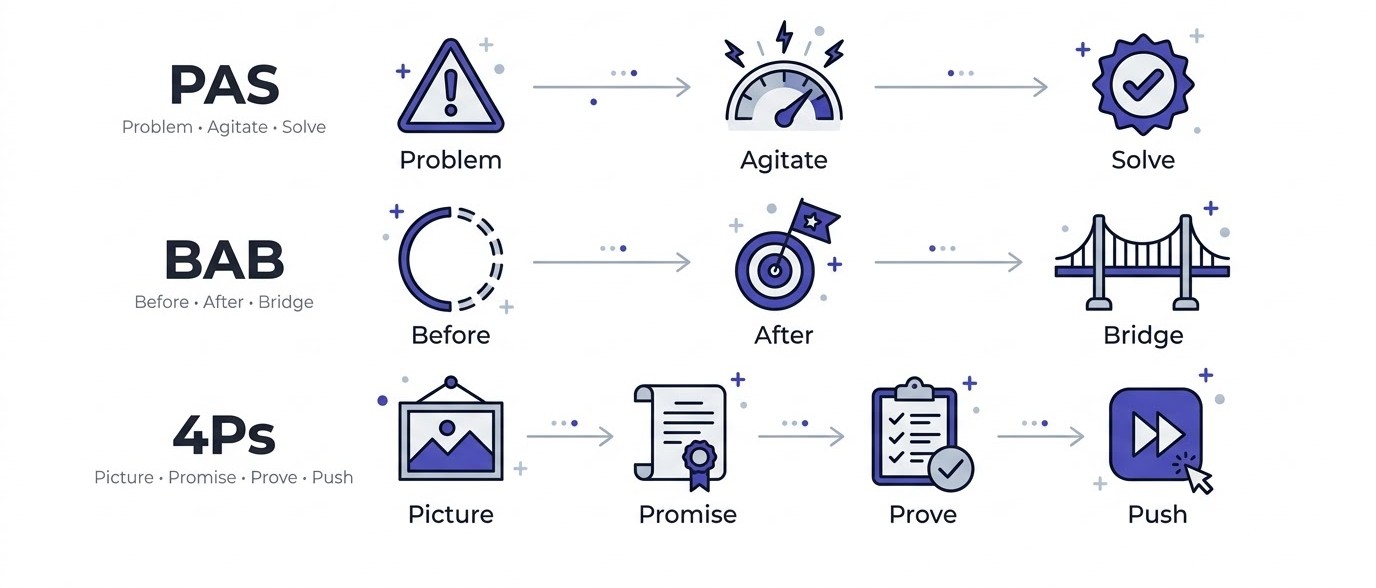
PAS, BAB and the 4Ps are copywriting formulas built around one idea: people act faster to escape a problem than to chase a benefit. Each one starts from the reader’s current pain or situation, then moves toward the change you’re offering. They suit emails, landing pages and ads where you’ve got a few seconds to prove relevance.
PAS: Problem, Agitate, Solve
PAS is probably the most-used of all copywriting formulas in emails and short sales copy. You name a problem the reader already has, make it feel uncomfortable, then present your offer as the way out. Three moves, nothing wasted.
Problem has to be something the reader would describe in their own words. “Struggling with productivity” is a label you’d write on a slide. “Your to-do list has 43 items and you did none of them today” is a problem someone actually feels. Agitate is where beginners get nervous, because it feels pushy. It doesn’t have to be. Agitating just means showing what happens if the problem keeps going: the missed deadline, the wasted money, the awkward conversation.
Solve comes last and should be short, because the reader is already leaning forward. Name the solution, say in one line how it works, and give the next step. Rushing to Solve before the problem has landed is the classic PAS failure, so give Agitate real room.
A PAS Example for a Small Business
Imagine a freelance accountant who sells a monthly bookkeeping service to small shop owners. Weak version: “We provide professional bookkeeping services for small businesses at affordable prices.” Nobody feels anything reading that.
PAS version: “The GST filing date is in four days and your purchase bills are in a shoebox. (Problem.) Miss it and late fees start piling up daily, your input credit gets tangled, and you spend the weekend on calls instead of with your family. (Agitate.) For a flat monthly fee, a real person sorts your bills every week, so filing day is a ten-minute check, not a panic. (Solve.)”
The shoebox is the detail that sells it. Any shop owner reading that sentence can see their own shoebox. Specific, slightly embarrassing, true. That’s the whole trick.
BAB: Before, After, Bridge
BAB works differently. Instead of leaning on pain, it paints two pictures: life before, life after, and then your product as the bridge between them. It’s gentler than PAS, which is why it fits products that sell a feeling or a lifestyle change, like fitness, courses or software that saves time.
Before describes the reader’s present situation honestly. After describes the same situation with the problem solved, in concrete terms they can picture. Bridge explains how they get there, which is where your product or offer comes in. Example for a budgeting app: “Right now, salary day feels great and the 20th feels like a lecture (Before). Picture reaching the end of the month with ₹6,000 still sitting untouched (After). Our app sorts every UPI payment into categories automatically, so the leak shows up in a week, not a year (Bridge).”
The common BAB mistake is a fuzzy After. “Happier, healthier, more productive” is a mood board. “₹6,000 untouched on the 30th” is a result. Make the After so specific that the reader could check whether it happened.
The 4Ps: Picture, Promise, Prove, Push
The 4Ps formula is a longer cousin of BAB, and it’s a favourite for sales emails and landing pages that need a bit of persuasion muscle. Picture paints the desired outcome so the reader sees it. Promise says plainly what you’ll deliver. Prove backs the promise with evidence. Push gives the nudge to act.
Prove is the step beginners skip, and it’s the step that decides whether the reader believes you. Proof can be a customer result with a name and a number, a short testimonial, a before and after screenshot, a guarantee, or a simple fact like “412 batches delivered since 2022.” You don’t need big-brand credibility. You need one believable detail.
Push is not the same as a polite goodbye. It’s a reason to move now: a seat limit, a date, a bonus that expires, or just the cost of waiting another month. Done honestly, it respects the reader’s time. Done with fake countdown timers, it burns trust, and readers notice.
Choosing Between PAS, BAB and the 4Ps
Quick rule of thumb. Use PAS when the reader is already annoyed and knows it, like someone searching “how to stop missing GST deadlines.” Use BAB when the reader is comfortable but could be better off, like someone who could save more but isn’t in pain. Use the 4Ps when the offer costs real money and the reader needs proof before trusting you.
You can also stack them. A long sales email can open with PAS for the first few lines, then switch to 4Ps for the proof and the push. Real copywriting formulas get mixed all the time. Just keep each paragraph’s job clear in your own head.
Copywriting Formulas for Headlines and Hooks
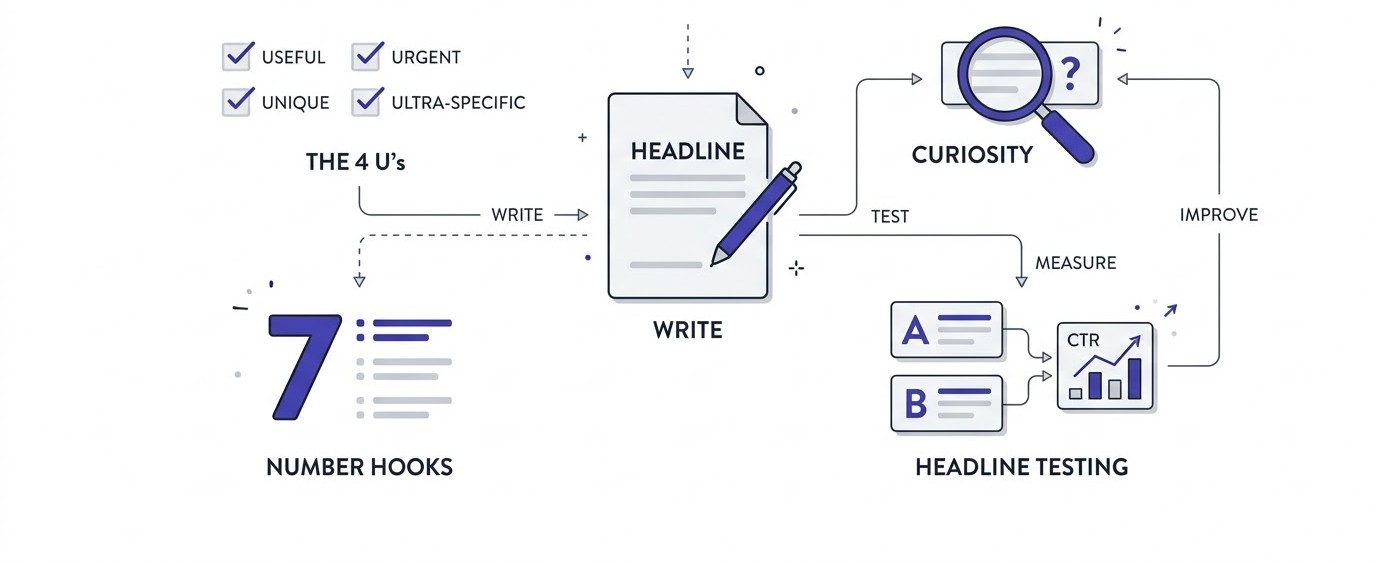
Headlines have their own copywriting formulas because they’ve got one brutal job: win a glance. On average, many more people read a headline than the copy underneath it, so a weak headline wastes everything that follows. These formulas help you write ten decent options fast, then pick the best.
The 4 U’s: Useful, Urgent, Unique, Ultra-Specific
Michael Masterson’s 4 U’s is the simplest headline checklist around. A good headline usually scores well on at least two of four things. Useful means the reader gets a clear benefit. Urgent means there’s a reason to read now. Unique means it says something they haven’t read a hundred times. Ultra-specific means it uses a concrete detail instead of a vague promise.
Take a weak headline: “Tips for Better Sleep.” It’s mildly useful, not urgent, not unique, not specific. Rewrite: “7 Sleep Fixes That Work Even If You Scroll Until 1 am.” Now it’s useful (fixes), specific (7, 1 am), and a little unique because it admits the reader’s bad habit instead of lecturing about it.
Don’t try to hit all four every time. Forcing urgency into a headline that doesn’t deserve it feels fake. Score a few drafts, keep the one with the best mix, and move on.
Curiosity and Number-Based Hooks
Curiosity headlines open a gap between what the reader knows and what they want to know. “The one thing most new freelancers forget to put in an invoice” works because the reader suddenly wants to check their own invoices. The danger is clickbait: if the article doesn’t pay off the gap, readers feel tricked and leave, and they remember.
Number headlines work for a different reason. A number promises a defined, finite amount of reading. “9 Ways to Write a Cold Email” feels easier to start than “How to Write a Cold Email,” since the reader can see the end. Odd numbers like 7 or 9 often feel more real than round ones, though that’s more a habit among writers than a law.
Both hooks need honesty. If the headline says seven fixes, give seven. If it hints at a secret, deliver something the reader genuinely didn’t know. Otherwise the click is wasted and the next headline from you gets ignored.
How-To, Question and “Without” Headlines
How-to headlines are the workhorses of search and email: “How to Write a Product Description in 15 Minutes.” They match what people type into Google and promise a clear skill. Add a time frame or a result and they get stronger.
Question headlines work when the question is one the reader is already asking in their head: “Is your landing page losing you half your leads?” Avoid questions with an obvious “no” answer. And “Without” headlines take away an objection: “Learn Photoshop Basics Without Buying Expensive Software.” The reader’s main worry is handled inside the headline itself.
Write at least ten headlines per piece using these types, even if eight of them are bad. The ninth is often the one. Professional copywriters do this every day, and the quantity is the secret.
Testing Headlines Without Fancy Tools
You don’t need enterprise software to test headlines. Email platforms like Mailchimp let you run an A/B test on subject lines: send version A to 20% of your list, version B to another 20%, and the winner goes to the remaining 60%. Facebook and Google Ads both let you run two ad variations side by side with a tiny budget.
Starting out with no audience at all? Post two headline options in a small group chat and ask which one people would click. It’s rough, but it beats guessing. What matters is building the habit of checking, since your favourite headline and the reader’s favourite headline are often different.
Keep a simple log: headline, where it ran, clicks. After thirty entries you’ll start seeing your own patterns, like whether your audience prefers numbers or questions. That log becomes more useful than any list of copywriting formulas, because it’s built on your readers.
Copywriting Formulas for Emails and Social Media Posts
Emails and social posts squeeze the same copywriting formulas into tighter spaces. An email gets a subject line, a preview and a few short paragraphs. A social post gets one or two lines before the “see more” cut. Same structures, smaller containers, so every sentence has to justify its place.
Writing Emails With Star, Story, Solution
Star-Story-Solution is a friendly formula for emails that need to feel human. The Star is a person: a customer, a student, a client, or the reader themselves. The Story is what happened to that person, told in a few short lines with a real problem and a real turning point. The Solution is how your offer fits into that story.
Here’s a quick example for an online Excel course. Star: Meera, a junior analyst at a Pune logistics firm. Story: she spent every Friday copy-pasting 11 sheets into one report, and her manager still found errors on Monday. Solution: she learned three formulas in a week, the report now builds itself in four minutes, and she now owns the report instead of dreading it.
Why does this beat a plain pitch? People remember stories and forget feature lists. The reader thinks “that sounds like me” before they’ve even noticed they’re being sold to. Just don’t invent the Star. Use a real customer, with permission, or say clearly it’s a composite example.
Subject Lines, Previews and the First Line
The subject line is the headline of an email, so the headline formulas above all apply. The preview text (the grey snippet next to it) is a second headline most beginners ignore. If the subject creates curiosity, let the preview add a specific detail. Subject: “The invoice mistake that cost me two weeks.” Preview: “One missing line, and the client’s finance team froze the payment.”
The first line of the email body has to continue the thought, not restart it. Skip “Hope you’re doing well” and the long greetings. Start inside the story or the problem, since the reader already decided to open and now wants proof it was worth it.
Keep subject lines short enough to survive a phone screen, usually under 45 characters. Test two versions each time. If email is your main channel, the email marketing guides cover list building, sequences and deliverability alongside copy.
Short Social Copy: Hook, Story, Offer
Social posts run on a compressed version of AIDA that many writers call Hook, Story, Offer. The Hook is the first line, the only one most people see on LinkedIn or Instagram before the “more” button cuts it off. The Story is two to six short lines that earn the reader’s attention. The Offer is one clear next step.
A LinkedIn example from a freelance designer: “I lost a ₹60,000 client over one font. (Hook.) The logo was right, the colours were right, but the proposal used a different typeface from the brand guide, and their founder noticed in three seconds. (Story.) Now every proposal I send comes with a one-page style check. Reply ‘checklist’ and I’ll send it over. (Offer.)”
That reads as a person talking, not a brand broadcasting. Remember to adjust to the platform: Instagram captions can run longer if the first line is strong, while X rewards compression. For more on planning posts around these structures, the social media learning section is a good next stop.
Calls to Action That Don’t Sound Desperate
A weak call to action says “Please buy now!!!” A strong one says what happens next in plain words: “Reply with your city and I’ll send three batch timings.” It’s small, specific and low-risk, so the reader can say yes without feeling like they signed a contract.
One call to action per message is a good rule. Asking readers to like, comment, share, subscribe and visit the website in the same post splits attention, and the reader picks none. Choose the single action that matters most for this piece.
Also, match the ask to the relationship. A stranger who has just met your brand will respond to “read the guide.” Someone who’s been on your list for six months can handle “book a call.” Asking too much too early is the fastest way to look pushy.
Copywriting Formulas for Product Pages and Sales Pages
Product pages and sales pages carry the heaviest load, since the reader is deciding whether to spend money. The copywriting formulas here (FAB, QUEST and a longer PAS or 4Ps flow) help you turn features into reasons, handle doubts, and guide a skeptical reader toward a decision without pressure.
FAB: Features, Advantages, Benefits
FAB is the simplest way to stop writing feature lists. A Feature is a fact about the product: “This backpack has a 28-litre capacity.” An Advantage is what the feature does: “It fits a laptop, a lunch box and a change of clothes.” A Benefit is what that means for the person: “You can go from office to gym without going home first.”
Most beginners stop at features, because features are easy to see on the product itself. But a reader doesn’t buy 28 litres. They buy not having to carry a second bag. Always keep asking “so what?” after each feature until you reach something a person would actually care about on a Tuesday morning.
In practice, you rarely write all three letters in order. Lead with the benefit, back it with the advantage, and tuck the feature in as proof. “Go from office to gym without a detour (benefit). Fits a laptop and a lunch box (advantage). 28-litre capacity, water-resistant fabric (features).”
QUEST: Qualify, Understand, Educate, Stimulate, Transition
QUEST suits long-form sales pages and detailed emails where the reader needs to be walked through slowly. Qualify tells the right reader they’re in the right place: “If you run a small online store and your ads keep burning money…” Understand shows you get their situation. Educate teaches them something useful, like why most ad accounts leak money, which builds trust.
Stimulate raises desire by showing what’s possible, often through results or stories. Transition is the handoff into the offer and the action: “Here’s how the program works, and here’s how to join.” Each step earns permission to take the next one.
The Educate step is the one that makes QUEST different from pushy copy. By teaching before selling, you prove you know the field. The reader who has just learned something from you is far more willing to listen to your offer than a reader who got a pitch in the first sentence.
Structuring a Long Sales Page
A full sales page usually weaves several copywriting formulas together. It might open with a headline using the 4 U’s, followed by a PAS section describing the problem, a BAB passage showing life after, FAB for the product details, proof (testimonials, numbers, guarantees), and a final Push with a clear button. Looks like a lot, but each block is the small formula you already know.
Order matters more than length. Put the biggest promise and the main button above the fold, so a ready buyer doesn’t have to scroll through your story. Then keep building the case below for readers who need more convincing. Repeat the call to action every few screens.
Handle objections openly. A short FAQ block that tackles “What if it doesn’t work for me?”, “Is there a refund?” and “How long does it take?” removes the doubts that quietly kill sales. Reading your own page as a skeptical stranger is the quickest way to find those gaps.
Product Descriptions That Actually Sell
A good product description is a tiny FAB plus a sensory detail. Compare “Cotton kurta, available in 5 colours” with “Soft cotton that survives a 40-degree afternoon and still looks ironed at 6 pm. Five colours, from sand to deep indigo.” Same kurta. The second description puts the reader in the afternoon.
Keep the details accurate. If the fabric is cotton blend, don’t write 100% cotton. Returns and bad reviews from over-promised copy cost far more than a modest, honest line ever loses. Specific and true beats exciting and fuzzy.
Finally, think about who is reading. A first-time buyer needs reassurance (size guide, return policy). A repeat buyer needs speed (reorder button, new colours). One page can serve both if the structure is clear.
How to Choose the Right Copywriting Formulas for Your Situation
Choosing among copywriting formulas comes down to three things: how much the reader already knows, where the copy will appear, and what you want them to do. Pick wrong and good writing falls flat. Pick right and even average sentences convert, because the structure matches the reader’s state of mind.
Match the Formula to the Reader’s Awareness Level
Eugene Schwartz described five stages of customer awareness in Breakthrough Advertising. The reader is unaware (doesn’t know they have a problem), problem-aware (feels the pain but doesn’t know solutions exist), solution-aware (knows solutions exist but not yours), product-aware (knows you but isn’t convinced), or most aware (ready, just needs the deal).
Unaware readers need a story or curiosity hook before anything else. Problem-aware readers respond to PAS, since you’re naming a pain they already feel. Solution-aware readers need BAB or a comparison that shows why your approach is different. Product-aware readers need the 4Ps with plenty of proof. Most-aware readers need a short, direct offer and a button.
This single idea explains why the same ad works on one audience and flops on another. A cold Instagram audience is mostly unaware or problem-aware. A retargeting email to someone who abandoned their cart is product-aware or most aware. Different people, different formulas.
Match the Formula to the Channel
Channel changes the container. Ads have a few words, so lean on hooks and AIDA. Emails give you a sequence of paragraphs, so PAS and Star-Story-Solution fit. Landing pages and sales pages have room for combinations of formulas. Social posts need the hook first and the story fast.
Search-driven blog content is a different animal again. A reader searching “how to write a cold email” wants the answer quickly, so a direct how-to structure beats a dramatic PAS opening. Respect the intent behind the search before you apply any formula.
A practical tip: look at what’s already working on that channel. Scroll the top posts, read the emails in your inbox that you actually opened, study the ads that follow you around. Reverse-engineer which formula they used, then try your own version.
Match the Formula to the Goal
What do you want the reader to do? If the goal is a click, headline formulas and AIDA do the job. If the goal is a reply, a short PAS email with a tiny ask works. If the goal is a purchase over ₹5,000, you need the 4Ps or a long QUEST page with real proof.
Smaller goals need lighter copy. Asking someone to download a free checklist doesn’t need 1,500 words. Asking them to join a ₹25,000 course probably does. Mismatching the length and the ask is a very common beginner error, and it explains a lot of disappointing results.
If you’re unsure, write the simplest version first: three sentences covering problem, solution, next step. Then expand only if the reader would still have questions.
A Simple Decision Table
Here’s a quick reference you can keep beside your keyboard. Situation: cold audience, short ad. Use AIDA. Situation: reader with an obvious pain, email or landing page. Use PAS. Situation: reader who could be better off, lifestyle or software offer. Use BAB. Situation: expensive offer, skeptical reader. Use the 4Ps or QUEST. Situation: product page with specs. Use FAB. Situation: any headline. Use the 4 U’s.
No table is perfect, and real writing is messier. Treat it as a starting point and adjust once you see how readers respond.
Mistakes Beginners Make With Copywriting Formulas
Most trouble with copywriting formulas comes from applying them mechanically. The structure is fine. The execution is where beginners trip, usually by sounding generic, skipping the reader’s actual situation, or following steps without thinking about what each one is for. These mistakes are fixable once you can spot them.
Sounding Like a Template
If a reader can feel the formula, the formula has failed. Copy that reads “Are you tired of X? Imagine Y! Our product does Z! Buy now!” has a skeleton showing through the skin. The fix is detail. Replace general lines with the exact number, name or moment from the reader’s life.
Try reading your draft aloud. Anything that sounds like a line from an old TV ad should be rewritten the way you’d say it to a friend over chai. Short sentences, normal words, a little humour if it fits.
If a sentence could appear on anyone’s website, delete it or sharpen it until it could only appear on yours.
Writing About Yourself Instead of the Reader
Beginners love opening with “We are a leading provider of…” or “Our team has 10 years of experience.” Nobody cares at the start. Readers want to know what’s in it for them. A useful test: count the “we” and “our” words against the “you” and “your” words. If “we” wins, rewrite.
Your credentials still matter, just later, as proof. Put them inside the Prove step of the 4Ps or the testimonial section, where they back up a promise instead of replacing one.
The same goes for feature obsession. Describing the product’s engineering in loving detail might fascinate you and bore your buyer. Turn each feature into a result the buyer would notice.
Skipping Research
Formulas can’t replace knowing your reader. A beautifully structured PAS email about the wrong problem is still the wrong email. Before writing, spend time where your readers talk: Reddit threads, Quora questions, Amazon reviews of similar products, comments on competitor ads, and your own customer messages.
Copy the exact phrases people use to describe their problems. “My ads burn money” will always beat “suboptimal return on ad spend.” The most persuasive line in your copy is often one a customer already wrote for you.
Ten minutes of reading real reviews can improve a draft more than an hour of polishing sentences.
Overpromising and Fake Urgency
A formula gives you a way to create desire, and desire is easy to inflate. “Double your income in 30 days” gets clicks and refunds. Promise what you can deliver, and let proof carry the excitement. Honest copy builds a list of people who trust you, which beats a list of people who clicked once.
Fake urgency has the same problem. Countdown timers that reset every time the page reloads are easy to spot, and readers screenshot them. Use real deadlines: seat limits that are real, offers that actually end.
Indian consumer-protection rules and the Advertising Standards Council of India (ASCI) both take misleading claims seriously, so exaggerated claims aren’t just a trust issue but can become a legal one too.
Never Editing the First Draft
Formula-based drafts are fast, which tempts beginners to publish immediately. Don’t. The first draft’s job is to exist. Editing makes it good. Cut every sentence that doesn’t do its step’s job, shorten long ones, replace abstract words with concrete ones, and read the whole piece for rhythm.
Try the “sleep on it” rule when time allows. Reread tomorrow with fresh eyes and you’ll spot weak lines instantly. When there’s no time, at least read it aloud once and fix every spot where you stumble.
A useful editing pass: highlight the call to action, then check that the first sentence, the middle and the ending all lead toward it. If a paragraph pulls attention elsewhere, trim it.
How to Practice Copywriting Formulas Until They Feel Natural
Reading about copywriting formulas teaches you the names. Practice teaches you to use them. The goal is for the structure to become second nature, so you stop thinking “now comes Agitate” and start feeling when a draft needs more tension. That takes repetition, and it’s surprisingly quick if you do small daily reps.
Build a Swipe File
A swipe file is a folder of copy you admire: ads, emails, landing pages, social posts, subject lines. Save them in a Notion page, a Google Doc or a screenshot folder. Whenever something makes you stop scrolling or open an email, save it and write one line about why it worked.
Better still, label the formula. “This is PAS.” “This is BAB with a bridge about price.” After 30 or 40 entries, you’ll recognize patterns instantly, and you’ll have your own library to borrow from when a deadline hits.
The swipe file isn’t for copying. It’s for training your eye. Borrow structure and technique, never wording.
Rewrite Real Ads by Hand
Pick a weak ad or landing page, ideally from a local business, and rewrite it using one formula. Do the same ad again with a different formula. Compare the versions. You’ll feel how each formula changes the emphasis and tone.
Another good drill is handwriting or retyping a great sales letter word by word. It sounds old-fashioned and it works: you absorb rhythm, sentence length and pacing in a way that reading alone doesn’t give you. Ten minutes a day is plenty.
If you want a quick way to check readability and headline strength as you practise, the free marketing tools on the Academy of Digital Marketing site are handy for sanity checks.
A 30-Day Practice Plan
Week one: write ten headlines a day using the 4 U’s, number hooks and how-to patterns, and keep the best one. Week two: write one AIDA ad and one PAS email per day for an imaginary product. Week three: write a BAB social post and a 4Ps email, then add a FAB product description. Week four: combine them into a full landing page for a real or pretend offer.
Share your drafts with one friend or a small community and ask a single question: “Where did you lose interest?” That answer is worth more than any compliment. Fix that spot and try again.
Measure What Happens
Copy that never gets measured never improves. Track open rates for emails, click-through rates for ads, reply counts for outreach and conversion rates for landing pages. Write the formula you used next to each result in a simple spreadsheet.
After a month or two you’ll see which formulas your audience responds to. Maybe your readers love BAB but ignore PAS. Maybe numbers in subject lines lift opens by a few points. Those findings are personal, and they’re more valuable than any generic list.
Don’t chase tiny differences from tiny samples. A subject line test with 40 recipients proves nothing. Wait until each version has a few hundred views, or at least treat early results as hints, not verdicts.
Conclusion
Copywriting formulas won’t write the piece for you, but they take away the part that makes beginners freeze: not knowing what comes next. Learn AIDA first, add PAS and BAB, borrow the 4 U’s for headlines, and pull out FAB, QUEST or the 4Ps when the offer gets bigger. Fill each one with details only you or your customer would know.
This week, pick one real thing to sell, even a pretend product, and write it three ways: AIDA, PAS and BAB. Read all three aloud, keep the one that sounds most like a person, and send it to someone for a reaction. That small loop, repeated, is how copywriting formulas turn into a skill.
Frequently Asked Questions
What are copywriting formulas?
Copywriting formulas are proven structures that guide the order of ideas in persuasive writing. Each one breaks a message into steps, such as attention, interest, desire and action in AIDA. They help writers draft faster, stay focused on the reader, and avoid the blank-page problem, especially when writing ads, emails and landing pages.
What is the best copywriting formula for beginners?
AIDA is the best starting point because it’s simple, flexible and works across ads, emails and short pages. Once AIDA feels comfortable, add PAS for problem-focused emails and BAB for selling a change. Beginners get better results mastering two formulas than skimming ten.
What is the difference between AIDA and PAS?
AIDA follows the reader’s journey from noticing to acting, so it suits general promotion. PAS starts with a problem the reader already feels, makes it uncomfortable, then offers the solution. PAS is usually stronger when the reader has a clear pain, while AIDA is stronger for broader audiences who may not feel any pain yet.
How do I use the PAS formula in an email?
Open with a specific problem in the reader’s own words, spend two or three lines showing what happens if it continues, then present your offer as the fix with one clear next step. Keep the Solve section shorter than the Agitate section, and avoid exaggerating consequences, since honesty protects trust.
What are the 4 U’s of copywriting?
The 4 U’s are Useful, Urgent, Unique and Ultra-specific. Michael Masterson’s checklist helps judge headlines: a strong one usually hits at least two. It’s a quick way to compare several drafts and choose the one with the clearest benefit and the most concrete detail.
Do copywriting formulas still work today?
Yes, because they’re based on how people make decisions, not on a platform trend. AIDA is more than a century old and still shapes ads, emails and social posts. The words and channels change, while the underlying order of attention, relevance, desire and action stays the same.
Can copywriting formulas make my writing sound robotic?
Only if you fill them with generic lines. The structure is invisible when the details are specific: real numbers, real customer language and real situations. Read drafts aloud and replace anything that sounds like an old ad slogan with how you’d say it to a friend.
How many copywriting formulas should I learn?
Start with three: AIDA, PAS and BAB, plus the 4 U’s for headlines. That set covers most beginner needs. Add FAB, the 4Ps and QUEST later as your projects get longer or your offers get more expensive. Depth with a few beats a shallow list of twenty.
What is the BAB copywriting formula?
BAB stands for Before, After, Bridge. You describe the reader’s current situation, picture the same situation with the problem solved, then position your product as the bridge between the two. It works well for lifestyle changes, software that saves time, and any offer that sells a clear transformation.
How do I choose the right copywriting formula?
Check three things: the reader’s awareness level, the channel and the goal. Unaware readers need a story or hook, problem-aware readers respond to PAS, solution-aware readers like BAB, and skeptical buyers need proof through the 4Ps. Short ads suit AIDA, and long sales pages suit combinations.
Can I use more than one copywriting formula in the same piece?
Yes, and experienced writers do it all the time. A sales email might open with PAS, move into 4Ps for proof, and close with a short AIDA-style call to action. Just keep each paragraph’s job clear so the piece doesn’t wander.
How long does it take to learn copywriting formulas?
The basic structures can be learned in a weekend, but using them well takes practice. Most beginners notice real improvement after about a month of daily drills like writing headlines, rewriting ads and tracking results. Fluency, where the structure becomes automatic, usually comes after a few months of regular writing.
Do I need to follow copywriting formulas exactly?
No. Formulas are scaffolding, not rules. Beginners should follow them closely to learn the logic, then bend them as they gain confidence. If a step is unnecessary for a particular reader, skip it. The reader’s response is the only real test of whether the structure worked.