

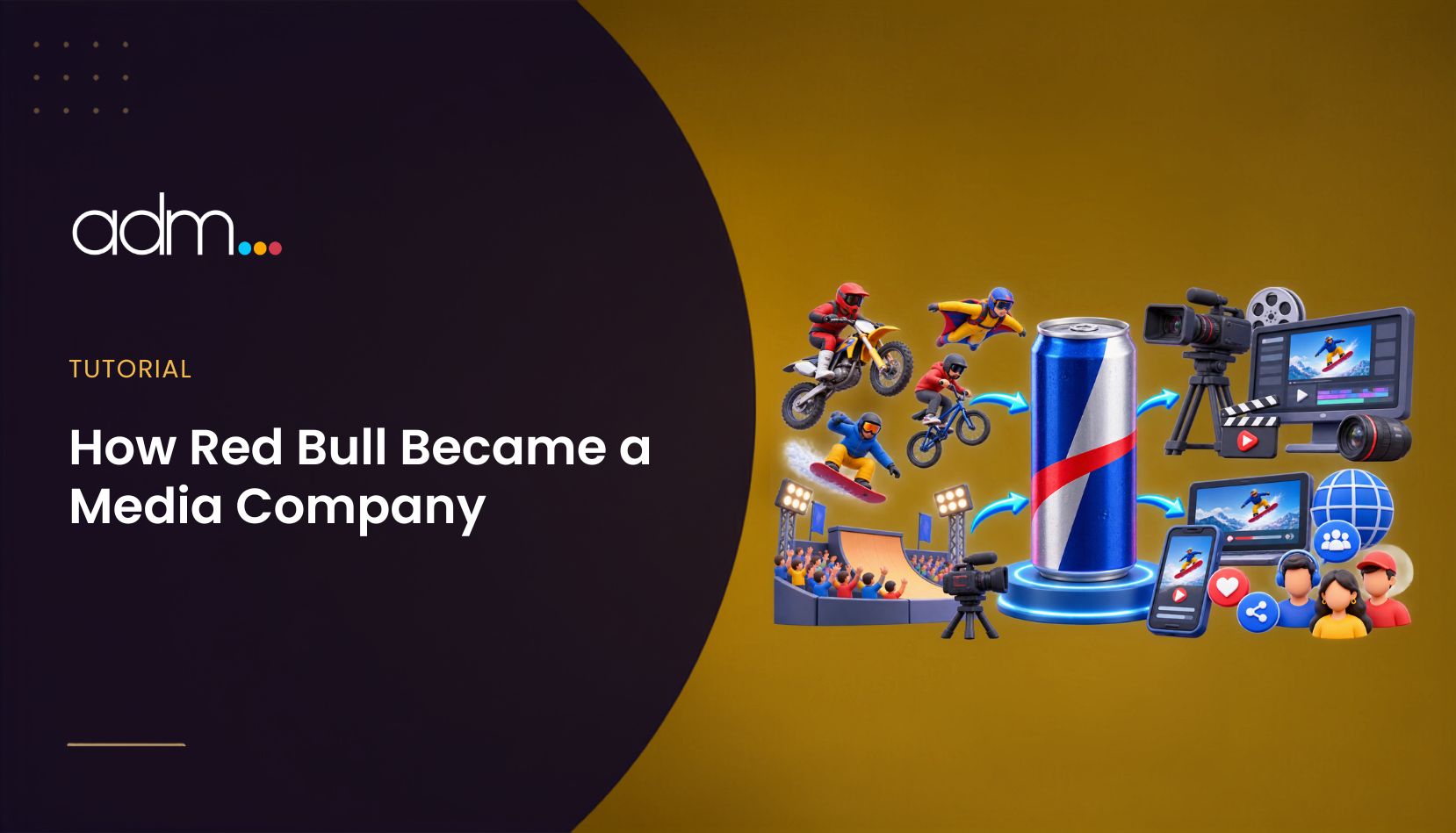
Picture a small beverage brand with a decent product and a marketing budget that would not cover one prime-time TV slot. Option one is to buy ads and hope somebody remembers them. Option two is to do what Red Bull did, which was to stop thinking like a drinks company at all. That second option is exactly how Red Bull became a media company, and it took a strange-tasting can from Austria to almost 14 billion cans sold in a single year.
Take October 14, 2012. A skydiver named Felix Baumgartner stepped off a tiny platform roughly 39 kilometres above the New Mexico desert, fell for a little over four minutes, and went faster than the speed of sound with a pressure suit and a parachute between him and the ground. More than 8 million people watched the live stream on YouTube at the same time. Nobody in that audience was being sold anything in the usual way. No 30-second spot, no discount code, no pitch. Just a logo on a capsule and a man about to do something nobody had done.
Here is the odd part. Red Bull still makes a drink, and a very profitable one. The company reported 13.969 billion cans sold in 2025 and group turnover of €12.196 billion. But look at where the energy, the people and the creativity actually go, and the drink starts to look like the receipt. The real work is staging events, owning racing teams and football clubs, and running magazines, a music label, a film operation and a footage library that other media companies license. The can is how all of that gets paid for.
So this guide walks through the whole thing in order, without the consultant gloss. You will see where Red Bull came from, why the early years already pointed this way, what Red Bull Media House actually does, why buying an F1 team made more sense than sponsoring one, and what a small brand with no billionaire behind it can steal. If you like brand teardowns, the case studies section here has more of them, but this one is a good place to start because almost every marketer has an opinion about Red Bull and most of those opinions are a little off.
What You Will Learn in This Guide
Here is what the next few thousand words cover, so you can jump to the part that matters most to you. Each point below gets its own section with specific names, dates and numbers instead of vague theory.
- Where Red Bull really came from, and why its earliest marketing already looked like media
- The difference between sponsoring events and owning them, with real examples like Flugtag and Rampage
- How Red Bull Stratos pulled more than 8 million live viewers without a single traditional ad
- What Red Bull Media House does, from magazines and film to music and footage licensing
- Why Red Bull bought F1 teams and football clubs, and what that did to its content engine
- What a small brand can copy, and which mistakes make copycats fall flat
TL;DR
- Red Bull sells drinks, but it spends its creativity on producing stories, events and teams that people watch for their own sake.
- The early years of campus brand managers, nightlife and a slogan about wings already treated attention as the real product.
- Owning events like Flugtag and Rampage gives Red Bull footage, characters and licensing rights that a sponsor never gets.
- Red Bull Stratos in 2012 pulled more than 8 million concurrent YouTube viewers with almost no direct selling.
- Red Bull Media House, two F1 teams and several football clubs turned content into a weekly habit instead of a yearly campaign.
- Small brands can copy the ratio: pick one world, own a recurring format, build a library and stay patient.
How Red Bull Became a Media Company: The Origin Story Most People Skip
Most stories about how Red Bull became a media company start in 2007, when Red Bull Media House launched. That is too late to be useful. The habits behind the media arm formed in the 1980s and 1990s, when a former toothpaste marketer decided his drink would never be explained by its label. Start in the right place and the rest stops looking like luck.
A Thai Tonic, a Toothpaste Marketer, and a Jet-Lagged Idea
Dietrich Mateschitz was born in Austria in 1944 and spent years in marketing for Blendax, the German company behind Signal toothpaste. The job had him flying around Asia a lot. On a trip to Thailand in 1982 he tried Krating Daeng, a sweet, fizzy tonic that truck drivers and factory workers drank to stay awake on long shifts. The story he told for years was that his jet lag simply disappeared. Whether that is exact or polished by retelling, it was enough to make him curious.
The drink was made by Chaleo Yoovidhya, a Thai businessman whose company, TC Pharmaceutical, sold it. Krating Daeng roughly translates to red gaur, a wild bovine, which is where the red bull comes from. In 1984 Mateschitz and Chaleo each put in about half a million dollars and took 49 percent of a new company, with the last 2 percent going to Chaleo’s son, Chalerm. Yeah, the Thai side and the Austrian side were equal partners from day one.
What matters here is who Mateschitz was. Not a chemist, not a bottler, not a distributor. A brand person who found a product and then spent about three years building the story, the can and the plan around it. Brand first, liquid second. That order never really changed, and it explains almost everything that came later.
The Product Was Fine, the Positioning Was Odd
Honest question: if you tasted Red Bull blind, with no story attached, would you pay more for it than a Coke? Most people would say no. The taste is sweet and a bit medicinal, and plenty of drinkers have compared it to liquid candy. Mateschitz reworked the Thai recipe for European palates, carbonated it, and put it in a slim silver and blue 250 ml can that looked nothing like a soft drink. Then he priced it above cola.
On paper that is a terrible plan. A smaller can, an odd flavour and a higher price. The only way it works is if the drink means something other than refreshment. So it was never sold as a thirst-quencher. It was sold as a functional drink, something you take before you do something hard, with a slogan that promised wings. Regulators in Austria took their time approving the formula, so the launch slipped until April 1, 1987.
Look at what that forced. Because the product could not win on price or on taste, the brand had to win on meaning. Meaning gets built with stories, people and moments, which is basically the raw material of media. A company that sells a commodity can get by with ads. A company that sells a feeling has to create that feeling somewhere, over and over. That need is the seed of everything Red Bull Media House became twenty years later.
Starting on Campuses and in Clubs Before Anyone Called It Content
The early marketing was scrappy and very human. Red Bull hired students to act as brand managers on campuses, handing out cans and talking to people at parties, in libraries and before exams. Branded Mini Coopers with a giant can on the back drove around cities. Bars and clubs started mixing the drink with vodka, which turned Red Bull into a nightlife staple almost by accident. Some of the stories from that era, like staff leaving empty cans on bar tables to make a place look busy, might be half myth. They still fit the pattern.
The pattern was simple: go where the target audience already hangs out, and make the drink part of the scene instead of an interruption. The company also ran short, slightly absurd cartoon TV ads built around the wings line. Then it moved country by country: Hungary in 1992, the UK in 1993, Germany in 1994, and the United States, starting in California, in 1997. Each launch repeated the same recipe rather than reinventing it.
Back then, nobody called any of this content. But a student handing a can to a friend and telling the story is content in its oldest form. The brand was already behaving like a media company in one specific way: it cared more about where attention gathers than about where shelf space is. That lesson still holds. Brands burn money advertising to everybody when a well-chosen room of 200 people would have talked about them for a year.
Why the Early Years Matter for the Media Story
Three habits from this period carried straight into the media business. First, sell the scene, not the product. Second, pay for experiences instead of placements. Third, keep control of the story. Red Bull began backing extreme sports and mountain events in the late 1980s, including the Dolomitenmann relay race in Austria, and put its logo on the helmet of Formula 1 driver Gerhard Berger in 1989.
Sponsorship was the training wheels. Cheap, early and a bit of a gamble. But every sponsored event taught the team the same irritating lesson: you pay a lot, and the organiser keeps the footage, the audience and the story. Red Bull would later fix that by running its own events, and by 1992 it had launched Flugtag in Vienna, which comes up in the next section.
Seen this way, the media company was not a pivot. It was where the logic had been heading since the first student brand manager. Sell an attitude, find the people who live it, and make sure you hold the camera. The drink was always the funding mechanism. The market just took about twenty years to notice.
How Red Bull Became a Media Company by Owning the Stage Instead of Renting It
The big difference between Red Bull and nearly every other sponsor is ownership. Plenty of brands buy a spot at someone else’s party. Red Bull throws its own. This is the real engine behind how Red Bull became a media company, because every event it owns produces footage, characters and headlines it never has to rent.
Sponsoring Versus Owning: The Difference That Changes Everything
When a brand sponsors an event, it gets a logo, a mention and a slice of someone else’s audience. The organiser keeps the broadcast rights, the footage and the relationship with fans. Next year the organiser can take a bigger cheque from a rival and the brand goes home with nothing but memories. That is renting, and it is how most sports marketing works, including at competitors like Monster Energy, which spends heavily on sponsoring athletes, riders and fighters.
Owning flips every one of those terms. Red Bull decides the format, the venue, the camera angles, the athletes, the soundtrack and the release date. After the event, the footage belongs to Red Bull, which means it can cut a highlight reel, a documentary, a 20-second social clip and a licensing package from one shoot. One day of production gets reused for years.
A simple test is worth stealing. If the event ends and somebody else owns the tape, you rented it. If you own the tape, the idea and the date on the calendar, you built an asset. Small brands can do this too, just at smaller scale. A local running group that organises its own monthly race, with its own photographer, owns more than a brand that pays for a banner at a marathon.
Flugtag, Cliff Diving, Rampage and the Event Machine
Flugtag, which means flying day in German, started in Vienna in 1992. Amateur teams build homemade flying machines, push them off a pier into the water, and mostly fail in beautiful ways. It is cheap to produce, easy to understand and almost guaranteed to give you a clip people share. A man in a giant cardboard bird belly-flopping into a lake needs no translation in any language.
After that came a steady parade of events. Red Bull Air Race, where pilots raced planes through inflatable gates, ran from 2003 to 2019 with a break in the middle. Red Bull BC One put breaking competitions on a global stage from 2004. Red Bull Rampage, a freeride mountain bike contest in the Utah desert, started in 2001 and became a landmark in the sport. Cliff diving, ice-track racing and a dozen others filled the calendar.
Notice what these have in common. Each one produces visuals that look dramatic on a phone screen, and each one has built-in characters, stakes and a clear winner. They are also repeatable. A one-off stunt is nice. A yearly event with a name, a trophy and a following builds an audience that waits for the next edition. That is closer to a TV season than to an ad campaign.
Athletes as Characters, Not Billboards
Red Bull handles athletes differently from a typical sponsor. Instead of waiting for someone to become famous and then paying a premium, the company tends to sign people early, sometimes as teenagers, and funds their projects as well as their salaries. Max Verstappen is the clearest example. Red Bull put him into its junior programme as a teenager, and he went from there to Formula 1 at 17 and then to four straight world titles between 2021 and 2024.
That arc is the point. Audiences love stories with a beginning, a struggle and a payoff, and a long relationship with a young athlete hands the brand all three. By the time Verstappen was winning championships, millions of people felt like they had watched him grow up, with Red Bull in the background of every chapter. Sebastian Vettel’s path, from the same junior system to four consecutive titles from 2010 to 2013, followed the same shape.
The business lesson is pretty direct. Billboards get glanced at. Characters get followed. If your brand backs a small number of people it believes in, tells their stories honestly and sticks around when they lose, it builds something advertising cannot buy. A small brand can do this with a local chef, a young cricketer or a street artist, and the cost is a fraction of a celebrity deal. For ideas on turning that into daily posting, the social media guides on this site break down content calendars in plain terms.
Red Bull Stratos, the Jump That Beat Every Ad
Stratos is the cleanest proof of the whole idea. The project put Felix Baumgartner in a capsule lifted by a giant helium balloon. On October 14, 2012, he rose to about 39 kilometres, stepped out, and fell at a top speed of roughly 1,357 km/h, which is Mach 1.25. He broke records for the highest freefall and the fastest speed in freefall, and he landed on his feet in the desert.
The numbers around the stream matter more than the jump. Guinness World Records counts more than 8 million concurrent live viewers on YouTube, a record for the platform at the time. Mainstream news outlets covered it as a global event. Red Bull’s logo was on the capsule, on the suit and on the screen in the background, yet nobody felt sold to. People shared the footage because it was astonishing, not because it was an ad.
Red Bull has never published a tidy cost for the project, and any number floating around is a guess. That is fine, because the better question is what a normal media buy would have delivered for the same money. A traditional campaign buys interruptions that last seconds and vanish. Stratos produced a documentary, a stack of clips, a licensing library and a news cycle that kept running for weeks. And it still sits on YouTube, collecting views years later.
The honest caveat is that very few brands can pull off something like this, and Red Bull itself does not manage a Stratos every year. The takeaway for everyone else is the ratio. Spend on making something worth watching, then let the brand ride along quietly. The watching is the product.
Inside Red Bull Media House: How Red Bull Became a Media Company in Practice
Events are the spark, but a spark needs somewhere to go. That somewhere is Red Bull Media House, the in-house operation that turns raw footage and stories into magazines, films, music and licensing deals. It is where the claim that Red Bull is a media company stops being a slogan and starts showing up on an org chart.
The 2007 Decision to Put Content Under One Roof
Red Bull Media House launched in 2007, based in Austria, with a simple purpose: bring the company’s content production under a single roof. Before that, the company relied on agencies, freelancers and event crews who each handled one piece of the pipeline. Footage was scattered, rights were messy and every project started from scratch.
Putting a media operation inside the company changed the economics. A camera operator shooting an athlete for a magazine story could also shoot for a documentary. A photo taken at an event could end up in a feature article, a social post and a licensing library. Same shoot, many outputs. It also meant Red Bull could move fast, since nobody had to negotiate usage rights with an outside producer for every clip.
Most brands that try this fail because they treat the in-house studio as a cost centre that makes ads. Red Bull treated it more like a publisher with its own standards. The people there had to make things good enough to watch without the logo. That standard is the difference between brand content that gets ignored and brand content that people actually seek out, and it is still the hardest part to copy.
Magazines, TV and Records: The Parts Nobody Expects From an Energy Drink
The Red Bulletin, a monthly magazine that launched in 2005 and later joined the Media House family, ships with newspapers in several countries and covers sport, music, culture and adventure. It reads like a normal lifestyle magazine, with the drink barely mentioned inside. Terra Mater, a nature and science title, and Servus, a lifestyle magazine rooted in Austrian country living, follow the same approach: serious editorial, loosely connected to the parent brand.
Music ran in parallel. Red Bull Music Academy began in 1998 with workshops for young producers and DJs and ran for two decades, until 2019. Red Bull Records, founded in 2007, signed and released acts, including AWOLNATION, whose song Sail turned into a long-running streaming hit. In Austria the company also backs Servus TV, a broadcaster that launched in 2009.
Not all of this makes money by itself, and that is the point. Each piece reaches a different slice of people the brand wants to be around, from gearheads to hikers to bedroom producers. The drink never has to appear. Honestly, that restraint is the cleverest part. A magazine full of can photos is an ad. A magazine full of good stories about a rock climber is a magazine that happens to have a can on the back page.
Red Bull TV and the Content Pool: Distribution Without Buying Ads
Red Bull TV launched around 2013 as a free streaming service built around the company’s films, live events and series, available on smart TVs, consoles and phones with no subscription. It later changed shape, and most of that video now lives on redbull.com and on the big platforms like YouTube, which is where audiences already spend their time. The lesson is not that the app failed. It is that people go where the habit already exists, and a brand does better meeting them there than demanding a new download.
The less famous piece is the Red Bull Content Pool, a platform where Red Bull licenses its photos and footage to other publishers, broadcasters and brands. Think about that for a second. A drinks company sells video and imagery to news organisations. A news site that needs a clip of a snowboarder mid-air can license it, with the Red Bull name attached, and the brand spreads across hundreds of outlets without paying for a single ad slot.
That is what a media company does: it produces assets and then distributes them wherever demand exists. The difference is that Red Bull’s distribution partners often end up promoting the brand for it. The name shows up in credits, captions and watermarks, which is advertising nobody had to pay placement fees for.
Why a Drink Company Can Afford to Run a Studio
Cheap is not the explanation. Red Bull’s content operation costs a lot. The explanation is that the drink gives the group the money and the freedom to run it. In 2025 Red Bull’s group turnover was about €12.2 billion on nearly 14 billion cans, which works out to roughly 87 euro cents of turnover per can. Small per can, huge in total. A business like that can fund a studio, a stable of athletes and a calendar of events from its own cash.
Freedom matters as much as money. A normal publisher needs ad revenue, so it chases clicks and keeps advertisers comfortable. Red Bull’s content does not have to pay for itself, so it can run a slow, beautiful documentary about a climber, or a stunt that takes years to organise. The company is also privately held, with no listed stock and no quarterly earnings calls pushing for short-term results.
There is a trade-off. Content that is not accountable to a budget line can drift into vanity projects, and Red Bull has certainly had expensive ideas that went nowhere. But the structure explains why the company can think in decades. If you want to see how content turns into customers on a normal budget, the digital marketing guides on this site cover funnels and measurement in a way that fits a smaller business.
Red Bull as a Media Company: Why It Bought F1 Teams and Football Clubs
At some point sponsoring things stops being enough, so Red Bull went and bought the things. Two Formula 1 teams, football clubs on three continents and a whole sports empire sit under one brand. From a pure drinks view that looks silly. From a media view it is a content supply chain with weekly episodes.
Buying Jaguar for One Dollar
In late 2004 Ford was tired of losing money on its Jaguar Formula 1 team and sold it to Red Bull for a symbolic one dollar, with a commitment that the buyer would invest heavily in it. Red Bull rebranded the team as Red Bull Racing for the 2005 season and put Christian Horner in charge as team principal. The team was not good right away, and early seasons were mostly about building.
The patient part is easy to miss. Red Bull’s first race win came in 2009 at the Chinese Grand Prix with Sebastian Vettel, and then came four straight drivers’ and constructors’ titles from 2010 to 2013. Within about six years of buying a team Ford had given up on, Red Bull was world champion. Later came another long run of success with Max Verstappen.
Why this counts as a media move: an F1 team is a travelling content studio. Twenty-odd races a year, huge global audiences, constant drama, human stories in the garage and a logo on every car. Sponsoring a team means appearing in somebody else’s story. Owning one means being the story, with full control of the paddock content, the driver relationships and the narrative when things go wrong.
Two F1 Teams and Content Every Other Weekend
In 2005 Red Bull also bought Minardi, a small Italian team, and turned it into Scuderia Toro Rosso. That team later became AlphaTauri and, in recent years, RB and then Racing Bulls. The sister team works as a talent farm, a place where young drivers like Vettel and Verstappen learned the sport before moving up to the senior squad.
Two teams means more screen time, more storylines and a built-in promotion system. Fans follow a driver from the junior ranks to the main team, and every promotion or demotion becomes a news item. That pipeline of stories is something no sponsor can build, because a sponsor does not control who gets the seat.
Streaming made it bigger. Netflix’s Drive to Survive brought F1 to a younger, more global audience, and Red Bull and Mercedes famously sat out the first season before agreeing to take part. The brand benefited from the show without having to produce it, which is a neat example of a media company letting someone else’s platform carry its characters.
Salzburg, New York, Leipzig and Bragantino: The Football Side
Football followed the same logic. Red Bull took over the Austrian club Austria Salzburg in 2005, changed its name and colours, and angered plenty of longtime fans. In 2006 it bought the MetroStars in MLS and rebranded them as the New York Red Bulls. In 2009 it launched RB Leipzig in Germany, which climbed through the divisions and reached the Champions League semifinal in 2020. In Brazil it took over Bragantino in 2019.
Why football? Because football has weekly games, passionate fans and a permanent place in local news. Clubs also double as talent pipelines, spotting young players and selling them on to bigger teams, which helps pay for itself and creates more stories. Leipzig gave the brand a presence in a country where it had no sports identity of its own.
Be honest about the cost, though. Many supporters of other German clubs saw Leipzig as a corporate project dressed up as a club, and the criticism has been loud for over a decade. Red Bull accepted that heat because the weekly content and the big European platform outweighed it. Whether that trade works for your brand depends on how much goodwill you can afford to spend.
The Risk Nobody Likes to Talk About
Ownership means owning the bad days too. When a Red Bull team has a messy season, the brand takes the hit directly. A rough patch across 2024 and 2025, with the departure of star designer Adrian Newey and a change at the top of the F1 team, put the company in the news for reasons nobody in marketing planned. A sponsor can shrug at that. An owner cannot.
Then there is the human cost. Red Bull backs athletes who do dangerous things, and some have died doing them. That is the ugly side of the strategy, and brands sometimes treat it as a footnote. Felix Baumgartner, the man from Stratos, died in a paragliding accident in Italy in 2025, a reminder of how thin the margin is in this world. Anyone copying the approach should think hard about safety culture, not just reach.
Legal and reputational risks are ordinary too. In 2014 Red Bull agreed to a US class action settlement of roughly $13 million over claims that its wings slogan and performance promises were misleading, without admitting wrongdoing. And Mateschitz died in October 2022. His son Mark holds the Austrian side’s 49 percent, the Thai Yoovidhya family holds 51 percent, and a brand built this closely on one founder’s taste now has to prove it works without him.
What Small Brands Can Learn From How Red Bull Became a Media Company

Most people read the Red Bull story and say, nice, but we do not have a billion euros. Fair. Still, the moves that matter are mostly choices, not budgets. Here is what survives the trip down to a small business, and what falls apart on the way.
Pick One World and Stay Inside It
Red Bull’s world is pushing human limits: speed, height, skill, nerve. Everything fits that world, from cliff divers to breakers to F1 drivers. A cosy cooking show would not fit, and Red Bull does not make one. That narrow lane is what lets an audience understand the brand in two seconds, even though the product itself, a sweet caffeinated drink, has no obvious link to a mountain bike.
For a small brand, the exercise is to write one sentence that describes the world you want to own. A chai brand in Pune could pick slow mornings and the people who make them, then film its tea farmers, tasters and neighbourhood vendors. That is far more useful than posting festival greetings. The test is whether a new idea or video clearly belongs in the world. If you have to argue about it, it does not.
Most brands skip this step and then wonder why their feed looks random. They post an offer on Monday, a motivational quote on Tuesday and a meme on Wednesday. Nobody can describe what the account is about, so nobody follows it. Spending one afternoon on that single sentence saves months of drifting, and it makes every later decision about topics, partners and formats a lot quicker.
Own a Format Your Audience Can Come Back To
Red Bull does not make single things. It makes formats: Flugtag, Rampage, BC One, a documentary line. Formats give the audience a reason to return, and they give the team a repeatable process, which keeps costs down. A one-off viral video is luck. A weekly series is a habit, and habits are what brands actually want from people.
Small brands can build formats at their own size. A monthly live Q&A, a weekly 60-second Reel called Workshop Fix of the Week, a seasonal event with a fixed name. Pick one and commit for at least six months. Give it a name, a visual look and a schedule. Then plan it in a calendar so nobody is inventing it at 11 pm each time. A newsletter that recaps the format is a smart add-on, because it gives you an audience you own outside any platform.
Red Bull also owns the calendar. Every event has a date, and the audience knows roughly when to look. Predictability is underrated. People forget a brand that posts whenever it feels like it, but they remember one that shows up every second Thursday with the same thing. If you only copy one habit from this section, copy that one.
Build a Library, Not Just a Feed
A feed disappears. A library compounds. Red Bull’s footage gets reused for years: the 2012 jump still pulls views, and an old clip becomes news again whenever a record gets broken. Content only has a long tail when somebody cares about organising it and reusing it.
For small brands, that means shooting once and using the material many times, and putting your best work somewhere searchable. A tutorial on your own site can rank on Google for years, while a Story vanishes in 24 hours. Titles, descriptions and a sensible site structure matter, and the SEO basics are the cheapest way to keep older content working. A simple habit helps: after every shoot, list five different pieces you can cut from the same material.
Also keep your raw files organised. Name them, tag them, back them up. Red Bull’s licensing business only exists because somebody can find the right clip in seconds. A messy hard drive is a library you cannot use, and plenty of small teams discover that the hard way when they need a photo from last year and cannot find it.
Mistakes That Sink Copycats
The first mistake is copying the surface. Brands see a stunt and decide to do a stunt, without the long build underneath. Stratos took years of engineering, testing and partnership. A last-minute extreme video from a brand with no link to extremes just looks desperate, and audiences can smell it from a long way off.
Second comes impatience. Red Bull launched in 1987 and its biggest content moment arrived in 2012, twenty-five years later. Most small brands quit content after three months because likes did not move. Third is showing the product in every frame. If every video ends with a hard sell, it is an ad and people treat it like one. Fourth is measuring the wrong thing. Likes feel good but do not tell you whether people remember you, search for you or buy from you. Track return viewers, newsletter signups, branded search and sales from content-led channels instead.
Fifth is ignoring risk. Red Bull has paid for safety teams, legal teams and crisis handling for years. Small brands tend to skip all of that until something goes wrong. Make claims you can prove, get releases from anyone you film, and treat safety as a normal cost of doing business. None of it is exciting, and all of it keeps you in the game long enough for the slow strategy to work.
Conclusion
Red Bull’s story is not really about energy drinks. It is about a founder who decided, in the 1980s, that attention was the scarce thing and that the best way to earn it was to make things people wanted to watch. Everything else followed from that: the events, the athletes, the studio, the teams. That is how Red Bull became a media company, and the drink turned into the thing that pays for it.
The takeaway for anyone with a smaller budget is simple. Pick one world, own a format and build a library, then keep going for longer than feels comfortable.
Frequently Asked Questions
How did Red Bull become a media company?
Red Bull became a media company by moving from sponsoring events to owning them, then launching Red Bull Media House in 2007 to produce, publish and license its own content. Events, athletes, F1 teams and football clubs generate footage and stories, which become magazines, films, music, streaming and licensing deals. The drink business pays for the whole operation.
What is Red Bull Media House?
Red Bull Media House is the company’s in-house media arm, launched in 2007 in Austria. It produces and distributes content including The Red Bulletin magazine, films and documentaries, music through Red Bull Records, and a photo and video licensing platform called the Content Pool. It gives Red Bull direct control over how its stories are told and where they appear.
Is Red Bull a media company or a drinks company?
Financially, Red Bull is a beverage company, with 13.969 billion cans sold and €12.196 billion in group turnover in 2025. Strategically, it behaves like a media company, because most of its marketing effort goes into creating and owning content instead of buying ad space. Both descriptions are accurate, and the overlap is exactly what makes the model interesting.
Who founded Red Bull?
Red Bull was founded in 1984 by Austrian marketer Dietrich Mateschitz and Thai businessman Chaleo Yoovidhya, who made the original Krating Daeng tonic. Mateschitz built the brand outside Thailand, and Red Bull Energy Drink launched in Austria on April 1, 1987. Mateschitz died in October 2022 at the age of 78.
How many cans of Red Bull are sold every year?
Red Bull sold 13.969 billion cans in 2025, an increase of 10.2 percent on the year before. Group turnover rose 8.6 percent to €12.196 billion, and the drink is sold in 178 countries. The company ended 2025 with 21,924 employees, up from 19,973 at the end of 2024.
What was Red Bull Stratos and why did it matter?
Red Bull Stratos was a 2012 project in which Felix Baumgartner rose to about 39 kilometres in a balloon capsule and jumped, reaching roughly 1,357 km/h in freefall. More than 8 million people watched live on YouTube. It mattered because it showed that a brand could earn global attention by making something extraordinary instead of buying a traditional ad.
Why does Red Bull own F1 teams and football clubs?
Owning teams gives Red Bull control over a steady stream of content: races, matches, driver stories and behind-the-scenes footage. A sponsor only borrows someone else’s audience, while an owner controls the narrative and the footage. Teams also act as talent pipelines, which keeps fresh characters flowing through the brand’s stories year after year.
Does Red Bull make money from its content?
Red Bull does not publish a profit figure for its media arm. Some parts earn money directly, such as licensing photos and footage through the Content Pool, but most content exists to build the brand, and the drink business pays for it. It makes sense to think of it as a marketing investment with some side income.
Can a small business copy Red Bull’s content strategy?
Yes, though at a much smaller scale and with more patience. The useful parts are picking one clear world to own, building a recurring format, saving and reusing content in a library, and measuring return viewers instead of likes. Copying the stunts without the long-term groundwork usually fails, so start with one small series and keep it going.
How much caffeine is in Red Bull?
A 250 ml can of Red Bull Energy Drink contains about 80 mg of caffeine, roughly the same as a cup of coffee. It also contains taurine, B-group vitamins and sugars. Caffeine tolerance varies a lot between people, so anyone with health concerns or who is pregnant should check with a doctor.
What happened to Red Bull TV?
Red Bull TV launched around 2013 as a free streaming service for the company’s films, events and series. Over time the content moved into redbull.com and onto major platforms like YouTube, where audiences already watch video. The shift shows how brands do better meeting viewers on existing platforms than asking them to install a new app.
Who owns Red Bull today?
Red Bull GmbH is privately held. After Dietrich Mateschitz died in 2022, his son Mark Mateschitz inherited the Austrian side’s 49 percent stake, and the Thai Yoovidhya family holds the other 51 percent. Because it is private, the company chooses what financial information to publish, which is why only headline figures like cans sold and turnover are public.
How is Red Bull’s marketing different from Monster Energy’s?
Both brands spend heavily on action sports, but the approach differs. Monster mostly sponsors athletes and events run by other organisations, so it rents attention. Red Bull creates and owns many of its events, teams and media channels, so it controls the footage, the stories and the licensing rights. That ownership is the main difference.